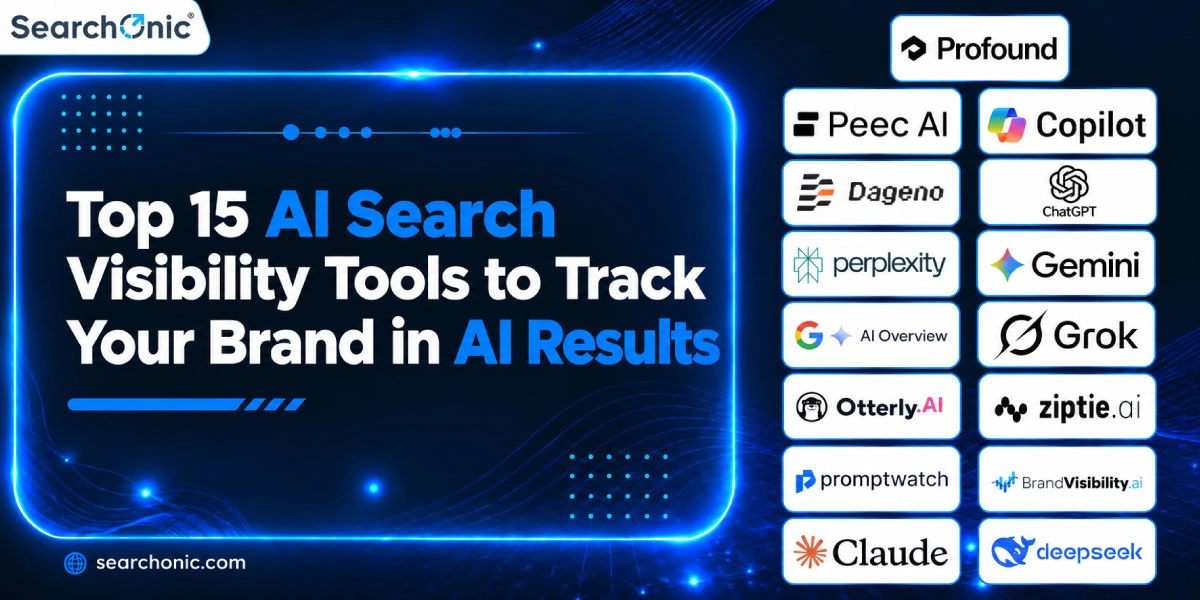
Top 15 AI Search Visibility Tools to Track Your Brand in AI Results
September 18, 2026 By Mit Thakkar
Summarize this blog post with:
Quick Summary
AI search visibility tools help businesses understand how their brand appears across AI-powered platforms like ChatGPT, Google AI Overviews, Gemini, Microsoft Copilot, and Perplexity. As users increasingly rely on AI-generated answers for research and recommendations, tracking brand mentions, citations, competitor presence, and sentiment has become essential.
By using AI search visibility tools along with generative engine optimization services, AEO, GEO, and AI optimization strategies, businesses can identify visibility gaps, improve content performance, and strengthen their presence in AI-driven search experiences. These insights help brands stay competitive as the future of search continues to evolve.
- Key Takeaways
- What Is AI Search Visibility?
- ⇒ Why AI Search Visibility Matters in 2026
- What Should You Look for in an AI Search Visibility Tool?
- Top 15 AI Search Visibility Tools
- 1. Profound
- 2. Peec AI
- 3. Microsoft Copilot
- 4. Dageno AI
- 5. ChatGPT
- 6. Perplexity
- 7. Gemini
- 8. Google AI Overviews
- 9. Grok
- 10. Otterly.ai
- 11. ZipTie.ai
- 12. Promptwatch
- 13. BrandVisibility.ai
- 14. Claude
- 15. DeepSeek
- How to Choose the Right AI Search Visibility Tool
- ➡ For Small Businesses
- ➡ For SEO & Marketing Teams
- ➡ For Enterprises
- ➡ For SEO Agencies
- How to Track Your Brand Visibility in AI Search
- ◈ Step 1: Identify Your Target AI Platforms
- ◈ Step 2: Build a Strategic Prompt Set
- ◈ Step 3: Establish Your Baseline
- ◈ Step 4: Monitor Changes Over Time
- ◈ Step 5: Optimise Content Based on the Data
- What Metrics Should You Track for AI Search Visibility?
- ➔ Brand Mention Rate
- ➔ Citation Rate
- ➔ AI Share of Voice
- ➔ Sentiment
- ➔ Prompt-Level Visibility
- ➔ Competitor Visibility
- Ready to Measure and Improve Your AI Search Visibility?
A few years back, ranking on Google’s first page was a necessity, but now that’s changing. Users’ search behavior is changing from traditional Google results to AI-generated answers. More people are asking ChatGPT a question and getting answers without clicking to a website. It is visible as Pew Research Center survey report 2026 shows that 60% of US adults found AI summaries helpful. So, now brands no longer rely on keyword rankings alone to measure visibility.
Now it’s a concern whether your brand is actually visible when AI tools answer questions. The most popular tools are Google AI Overviews, Google AI mode, Microsoft Copilot, ChatGPT, or Gemini. This is where AI optimisation services help a brand to improve its presence across AI-driven search experiences. Tracking mentions, citations, and sentiment matters in AI-generated answers and helps businesses measure AI visibility and identify gaps. The blog covers the 15 tools that help businesses monitor AI search performance.
What Is AI Search Visibility?
AI search visibility determines how consistently a brand appears in answers generated by AI-powered search platforms. These platforms analyze information from sites, databases, and other online sources to generate results and mention sources.
Traditional SEO visibility focuses on how well the site ranks for specific keywords in search engine results. AEO focuses on content optimization to offer direct answers to user questions. GEO aims on improving the chances of content being referenced in GenAI responses. AI search visibility calculates how a brand appears across AI-driven search experiences, including mentions, citations, and presence.
Businesses should track key metrics to understand performance, which are Brand mentions, Prompt-level visibility, AI citations, Citation frequency, Sentiment, Share of voice, and Competitor mentions. The best aio consultant can help businesses to understand these metrics and identify AI visibility gaps.
⇒ Why AI Search Visibility Matters in 2026
In 2026, consumers are widely turning to AI platforms for comparison, quick support, and recommendations rather than searching manually. AI-generated responses can influence users’ buying decisions. A strong ranking on the Google Search engine platform doesn’t guarantee that the brand will appear in AI responses. Partnering with top answer engine optimization companies helps businesses uncover content and authority gaps. They help to track AI presence and build visibility in AI responses.
What Should You Look for in an AI Search Visibility Tool?
✧ AI platform coverage – Evaluate whether the AI search visibility tool monitors visibility across AI platforms, including Google AI Overviews, Gemini, Copilot, and ChatGPT.
✧ Prompt tracking – Check for a tool which monitor specific prompts and shows how the brand appears across various AI-generated responses.
✧ Brand mention monitoring – The AI search visibility tools must identify when, where, and how frequently the brand is mentioned within AI-generated answers across various search platforms.
✧ Citation tracking – The best answer engine optimization services helps to choose the tool which identifies which pages and sources AI platforms use to reference your brand.
✧ Competitor comparison – Compare the brand’s AI visibility with competitors to understand who receives more citations, mentions, and recommendations in similar prompts.
✧ Share-of-voice analysis – Check the brand’s share of AI-generated mentions against competitors to understand your overall visibility within relevant search conversations.
✧ Sentiment analysis – Sentiment analysis showcases whether AI-generated responses describe the brand positively, negatively, or neutrally across various platforms.
Top 15 AI Search Visibility Tools
1. Profound

Profound is designed for enterprise brands & large marketing teams who require advanced AI visibility tracking. This top ai search visibility tools monitor prompts at scale, monitors citations across major AI platforms, and breaks down competitor share of voice. For businesses managing AI presence across multiple markets, Profound offers the analytical consistency the larger team requires.
2. Peec AI

Peec AI helps SEO and marketing teams seeking practical, real-time visibility tracking. It monitors how brands show up across prompts, identifies competitor activities, and prepares reports for regular follow-up. Rather than unnecessary data, it covers necessary AI search performance.
3. Microsoft Copilot

Microsoft Copilot is good for brands looking for visibility within Microsoft’s AI-driven search and assistant ecosystem. Copilot brings responses from live web data, identifies how your brand appears, reveal mentions, citations, and recommendations. It can compare your presence against competitors.
4. Dageno AI

Organizations that want a clear report about their presence across AI-generated results without any complications can choose Dageno AI. It tracks brand mentions, relevant prompts, and gives competitive metrics so the team understands where they stand. It’s a practical tool a company can choose if they are new to AI visibility monitoring.
5. ChatGPT

This enterprise AI search visibility tool has a massive user base and popularity. Businesses use this tool to run their own prompts to know how their brand, products, and services get described, suggested, and cited. It tells what millions of users see when they ask about your services/products.
6. Perplexity

Perplexity is the popular answer engine designed around citations, considered the key platform to monitor. It shows how well your content is positioned for AI-driven discovery rather than traditionally clicking tabs. It helps businesses monitor whether their brand appears as a cited source along with their competitors.
7. Gemini

Gemini is Google’s broader AI ecosystem, and monitoring it allows brands to understand visibility beyond search results. It evaluates brand mentions, competitor comparisons, and recommendations within conversational responses. Since Gemini integrates with other Google products, the response it gives can influence visibility across wide platforms.
Also Read: A Complete GEO Content Strategy Guide for Google AI Overviews
8. Google AI Overviews

AI overviews appear directly at the top of every Google search result, so it’s impossible to ignore them. Businesses must know if their content gets cited/mentioned, since these summary answers are shown to users before they click anything.
9. Grok

Grok is a good option for brand want to track how they appear in X’s conversational AI responses. It covers mentions, sentiment, suggestions, along with competitors’ visibility within prompt-based results. As the users of Grok increase, brands must know their AI visibility strategy to frame their content, services, and products.
10. Otterly.ai

This tool keeps things simple for firms that want straightforward AI search monitoring without a steep learning curve. It measures brand mentions, relevant prompts, citations, and competitor activity in one place. Firms who want to track their visibility without heavy setup, this is the most accessible option.
11. ZipTie.ai

It is designed for SEO teams for monitoring into AI search engines. It tracks AI mentions, citations, and performance along with monitoring the activities of your competitors.
12. Promptwatch

This AI tool focuses on prompt during monitoring, helpful for teams who want brief detail. It monitors how AI responses change across various formats. It monitors brand mentions, competitor presence, and visibility trends over time. It helps teams to understand which prompts improve or hamper their AI visibility.
13. BrandVisibility.ai

Among the best ai search visibility tools companies, it is designed to measure AI search presence. Businesses can use it to monitor brand mentions, prompts, and competitor activity. For brands prioritizing GEO as the core strategy, can choose it.
14. Claude

Claude shows how conversational AI frames your brand outside the tracked platforms. It reveals recommendations, mentions, and sentiment based on real prompts. The responses it offers might influence the user’s decisions while researching a product.
15. DeepSeek

This best AI search visibility tool represents a major LLM ecosystem. It is used globally by businesses to monitor brand mentions, suggestions, and competitors’ presence. Its different data sources and training can reveal visibility gaps and inconsistencies that other AI tools miss.
How to Choose the Right AI Search Visibility Tool
➡ For Small Businesses
Small businesses should select affordable tools that have an easy dashboard and prompt monitoring. Artificial intelligence optimisation services can use these tools while organizations focus on monitoring necessary brand mentions and citations.
➡ For SEO & Marketing Teams
They must select platforms offering detailed competitor analysis and visibility trends. Generative engine optimization consulting can use these insights across multiple AI platforms to identify performance gap and opportunities.
➡ For Enterprises
Enterprises must prioritize scalable platforms that support large prompt sets, APIs, detailed reporting, and multi-brand and location monitoring. Select a tool that offers security, compliance, and data protection capabilities.
➡ For SEO Agencies
Choose tools that support various clients, white-label reporting, competitor benchmarking, and automated reports. Tools from top answer engine optimization agencies allow businesses to easily manage campaigns.
Also Read: Best GEO Agency in Dubai for AI Search, SEO, and AEO
How to Track Your Brand Visibility in AI Search
◈ Step 1: Identify Your Target AI Platforms
To monitor brand visibility, first select the AI platforms that are relevant to your audience, including Google AI Overview, ChatGPT, Gemini, and Microsoft Copilot.
◈ Step 2: Build a Strategic Prompt Set
Now develop prompt sets that cover brand discovery, comparison, products and service searches, locations, industry-based questions, and “best queries” to understand visibility across various search queries and intent.
◈ Step 3: Establish Your Baseline
Monitor the current brand mentions, citation rate, voice share, sentiments, and competitor visibility to establish a baseline for measuring future AI search performance.
◈ Step 4: Monitor Changes Over Time
Monitor weekly or monthly changes, identify emerging competitors and missed prompts. Track performance after content updates or publications with support from an answer optimization company.
◈ Step 5: Optimise Content Based on the Data
The AIO services provider use performance data to strengthen topical authority, increase clarity, update existing content, build authoritative citations, and design content addressing missing queries.
What Metrics Should You Track for AI Search Visibility?
➔ Brand Mention Rate
It calculates how rapidly the brand becomes visible in AI responses across relevant platforms, prompts, and the user search journey.
➔ Citation Rate
It showcases how many times AI platforms cite the brand’s content or reference your website as a source when generating responses.
➔ AI Share of Voice
It gives a comparison of brand visibility with its competitors across various topics, prompts, and search conversations.
➔ Sentiment
It checks whether AI responses portray the brand positively or negatively across different prompts.
➔ Prompt-Level Visibility
It reflects how the brand performs for specific user prompts and queries. It helps businesses to identify strong-performing prompts and opportunities.
➔ Competitor Visibility
It showcases which companies also appear along/instead of the brand. Through this, firms can identify missed visibility opportunities.

Ready to Measure and Improve Your AI Search Visibility?
AI search is getting popular in 2026 because it works well beyond traditional ranking strategies. It helps businesses to understand how they can be visible in search results. Monitoring mentions, competitors’ presence, citations, and sentiment helps businesses know the areas where they need improvement.
For this, you can take help from generative engine optimization services in India. They guide brands on areas to focus on and strategies for improvement. The best tip is to start simple, create a prompt set, monitor the current baseline, and use insights for future improvements.
Key Takeaways
- Understand AI Search Visibility: AI search visibility tools help businesses track how their brand appears across AI platforms like ChatGPT, Gemini, Google AI Overviews, and Microsoft Copilot.
- Track Important AI Metrics: Monitoring brand mentions, citations, sentiment, share of voice, and prompt-level visibility helps measure AI search performance.
- Select the Right Visibility Tool: Businesses should choose AI search visibility tools based on platform coverage, competitor analysis, reporting features, and scalability.
- Improve AI-Driven Search Presence: Combining SEO, AEO, GEO, and AI optimisation strategies helps brands increase visibility in AI-generated responses.
- Monitor Competitors and Opportunities: AI visibility tracking helps businesses identify content gaps, improve authority, and discover opportunities to strengthen their AI presence.

Mit Thakkar
CEO & Co-founder at Searchonic & Midas Touch Infotech. I help Businesses To Increase Traffic & Leads with the Help of SEO.
Add as a preferred source on Google
Ready to Take Your Brand to the Next Level?
Let's Connect