A Complete GEO Content Strategy Guide for Google AI Overviews
July 10, 2026 By Mit Thakkar
Virtual search has changed, and that’s why content strategy needs to be changed. Finding data online means typing keywords into the search engine first. Market and product managers optimized web content so their sites can obtain a high ranking in SERP, which ultimately drives ROI.
A generative engine optimization service is an organized plan for developing, structuring, and distributing content to be cited in AI-powered platforms. Generative engine optimization services help get your content cited in AI-driven answers before a user clicks through. The sudden shift to these AI-driven searches is rapidly rising.
More than 50% of Google search results appear in Google AI overviews. As the adoption of GenAI tools & AI-driven searches is rising, Gartner predicts a 25% decline in traditional search volume. Following a complete GEO content strategy can boost AI visibility up to 40%. Brands must optimize content for both traditional SEO & AI-generated answers because now people are searching for information in 2 different ways.
Some users search through traditional search engines, whereas others rely on AI assistants. The balanced approach ensures your brand remains visible all the time. Following a balanced approach allows you to bring quality traffic, enhance brand authority, and improve user experience. To future-proof your marketing strategies, read the following GEO content strategy guide for Google AI overviews.
What Is GEO Content Strategy?
⮩ Meaning of GEO
GEO is the approach of content optimization to make it visible as a source on AI-generated platforms. In traditional SEO, the priority is to rank in search results. However, the generative engine optimization consulting team verifies the cited content when AI engines give users’ responses. The shift is driving this, and that’s why GEO is emerging as the core of the rapid adoption of AI-driven search tools. The key platforms that drive the adoption of GEO are:
● ChatGPT Search: A report said that 47.9% of ChatGPT’s top-cited sources are from Wikipedia in response to factual queries. The ChatGPT search feature brings responses from sites.
● Google AI Overviews: It appears at the top of your search page. These overviews focus on content that ranks well organically. It uses structured data markup.
Now users are widely relying on AI-generated answers alongside traditional search results. Organizations getting chosen for AI responses have better chances of reaching audiences who don’t like to visit a site.
⮩ GEO vs SEO vs AEO
As search frequently evolves, organizations need to understand the various roles of AEO, SEO & GEO. The following approaches share the common aim of enhancing online visibility; each is designed for a distinct search experience. Rather than replacing one another, they work well together to help brands reach users across AI-driven search platforms and search engines.
In GEO vs SEO content strategy, SEO prioritizes website visibility in traditional SERP. It includes keyword optimization, developing quality content, enhancing page speed and user experience, and following proven SEO practices. The primary goal is to drive organic ranking so users click through to your site from the SERP.
AEO is designed to support content appearing as direct answers. It emphasizes concise, structured & factual formats, FAQ sections, Schema markup & content which directly address user queries. Its goal is to offer instant answers without demanding that users browse various pages.
GEO performs content optimization for AI-driven queries for platforms like Google AI overviews & other gen AI search platforms. The generative AI optimization services prioritize building comprehensive, trustworthy, and citation-ready content that AI systems can confidently summarize. It involves demonstrating EEAT, building topical authority, using semantic optimization, and publishing original metrics, case studies, frameworks, and research.
The key difference is that SEO helps users discover your content, AEO helps answer specific queries, and GEO helps your content become a trusted source for AI-generated answers. As AI-powered search becomes prominent, businesses must view GEO as a component of their current SEO strategy rather than a replacement. Balancing AEO, SEO, and GEO, develop a comprehensive content strategy that enhances visibility across traditional search results. It gives featured answers and a unique search experience, ensuring long-term success.
Why Google AI Overviews Matter for Content Marketing
✦ AI Overviews Are Changing Search Behavior
Google AI overviews are managing the way users are searching & obtaining data online. Instead of searching for various search results, users can now receive AI-based summaries directly on the SERP. It helps to find answers quickly. These summaries involve links to verified sources for brief exploration and enable users to validate data.
The basic components that trigger AI overviews are informational searches, how-to guides, comparison queries, and query-based keywords. As a result, content marketers must move beyond keyword optimization and focus on developing comprehensive, clear content that directly answers users’ queries. Organizations that align their content with users’ intent & offer valuable, trustworthy data have more chances to be visible on AI-powered search experiences.
✦ Why Brands Should Care
Google AI overviews are transforming the way users interact with SERP, making visibility more competitive for brands. Since AI-generated summaries can answer queries before users click on a site, businesses must develop content that is verified, easy to understand, and referenced. Brands that invest in generative search optimization services can enhance their chances of being visualized in AI-generated responses by developing original research.
The generative engine optimization services in India are backed by expert insights, practical examples, and well-organized content. Following EEAT approaches, using a structured format and addressing user intent clearly can help AI systems recognize content reliability. Rather than focusing on traditional rankings, firms must optimize for both search engine and AI-driven search experiences. The approach strengthens brand authority, drives online visibility, and helps organizations rank to benefit from AI-driven search.
How Google AI Overviews Selects and Uses Content
◈ Content Quality Signals
Content that is actually helpful, reliable, and in line with user intent is what Google AI Overviews are intended to highlight. However, Google doesn’t release a precise algorithm for how AI Overviews choose sources. Producing authoritative, high-quality content makes your pages more likely to be taken into consideration. Pay attention to these important indicators of content quality:
➣ Instead of only focusing on keywords, publish useful, people-first content that puts the needs of users first.
➣ Provide clear summaries and thorough explanations in response to customer inquiries.
➣ To show knowledge and offer distinctive value, incorporate unique ideas, professional opinions, and practical experience.
➣ By providing thorough coverage of topics through pillar pages and supporting content clusters, you can establish strong topical authority.
➣ To improve dependability and E-E-A-T, leverage your content with reliable sources, reliable references, and correct facts.
➣ To keep content accurate and relevant for both consumers and AI systems, update it with the most recent data, figures, examples, and industry advancements.
◈ Technical and On-Page Signals
Google AI Overviews rely on solid technical underpinnings in addition to high-quality content to comprehend, assess, and surface web pages. Search engines and AI systems can more easily crawl, evaluate, and extract verified information from well-optimized webpages. Pay attention to these crucial on-page and technical signals:
➣ To arrange content logically and make it easier for people and search engines to read, utilize a clear heading hierarchy (H1, H2, and H3).
➣ To help AI systems successfully interpret page information, maintain clear HTML formatting with appropriately structured elements.
➣ Use accurate schema markup, such as FAQ, Article, or How-To schema, to give your content more context.
➣ Enhance Core Web Vitals and compress graphics to make pages load more quickly.
➣ Ensure the layout is easy to navigate to provide a consistent experience on all devices.
➣ Maintaining a logical site structure, internal linking strategy, XML sitemap, and well-configured directives will improve crawlability and indexability.
Also Read : Top GEO Agencies in India for AI Search Visibility in 2026
Step-by-Step GEO Content Strategy for Google AI Overviews
Step 1: Identify AI Overview-Friendly Keywords
Choosing keywords that frequently result in Google AI Overviews is the cornerstone of a successful GEO content strategy. Use phrases like “how,” “what,” “why,” “best,” “cost,” and “comparison” when conducting question-based searches, as these frequently indicate informational intent.
Prioritize long-tail keywords that are obviously relevant to user demands, and check search engine results to determine if AI Overviews are already there. This supports traditional SEO performance and helps you find chances where optimized content has a higher probability of appearing in AI-generated answers.
Step 2: Build Topic Clusters Around User Intent
Divide content into a topic cluster rather than posting individual articles. Create a thorough pillar page that covers the core issue and leverage it with in-depth blogs that address related questions, comparisons, tutorials, and more complex subjects. To enhance navigation and authority, interlink these pages with informative anchor text. Search engines and AI systems may more easily identify your website as a reliable source for a whole topic rather than just a single term thanks to this structure, which helps them comprehend your area of knowledge.
Step 3: Write Direct Answers for AI Extraction
Google AI Overviews favor clear, organized responses that immediately respond to user inquiries. Include a 40–60-word answer block that provides a straightforward, factual explanation of each significant heading. Avoid complicated language, use question-based H2 and H3 headings, and make each response simple to read. Companies that provide generative engine optimization services in India should concentrate on producing content that adds value right away and organically incorporates accurate keywords without compromising readability or user experience.
Step 4: Add E-E-A-T to Every Content Piece
A key component of AI-driven search visibility is E-E-A-T. Showcase actual industry experience, professional insights, author credentials, and useful examples to make each post stronger. When necessary, include case studies, original research, client success stories, screenshots, and reliable outside references. Ensure the data is accurate & frequently update publication dates. These trust signals boost the possibility of citations and increased search exposure by assisting AI systems and search engines in judging your content as trustworthy.
Step 5: Use Structured Content Formatting
Both people and AI systems can comprehend well-structured content more easily. Clear H1, H2, and H3 headings should be used to arrange content. When appropriate, bullet points, numbered steps, comparison tables, and clear summary boxes should come next. When applicable, employ structured data, such as FAQs or article schemas, to address frequently asked user questions. In addition to increasing the likelihood of appearing in Google’s featured search experiences, proper formatting also helps readability and information extraction for AI Overviews.
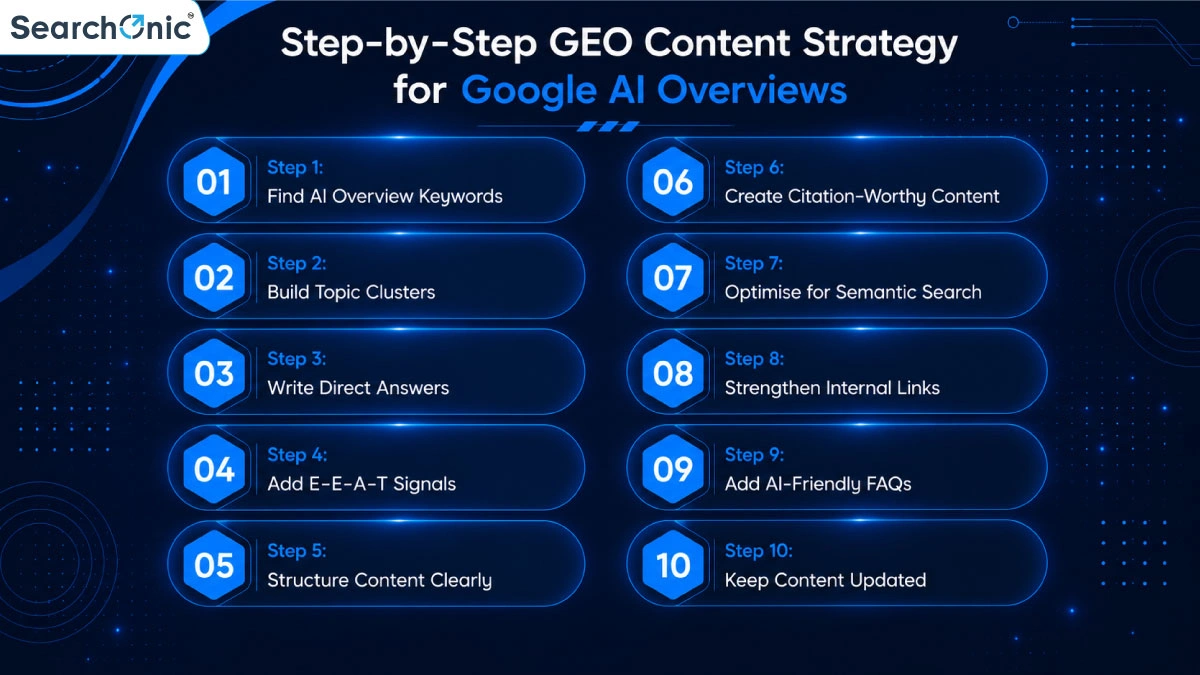
Step 6: Create Citation-Worthy Content
Instead of duplicating content that is already widely known, AI systems are more likely to cite stuff that has distinctive value. Publish unique frameworks, exclusive techniques, industry studies, useful templates, and actionable checklists that are difficult to find elsewhere. Incorporate real-world examples from your experience along with confirmed facts and reliable sources to improve your conclusions. Your website is more likely to be cited in AI-generated responses if it has useful resources like GEO audit tables, optimization frameworks, and content scoring methods.
Step 7: Optimize for Semantic Search
Instead of only using exact-match keywords, modern search engines assess concepts. Incorporate relevant terms like “generative engine optimization,” “AI search visibility,” “answer engine optimization,” “entity-based SEO,” and “search intent optimization” to build semantic relevance. Address any follow-up queries customers may have and provide thorough coverage of supporting subtopics. Avoid keyword stuffing and prioritize contextual relevance instead. A semantically rich article increases its appearance across several related searches and helps AI understand your content more properly.
Step 8: Strengthen Internal Linking
A robust internal linking structure enhances AI content discovery as well as user navigation. Using informative, keyword-rich anchor text, link pillar sites to case studies, reference articles, relevant service pages, and supporting blogs. Distribute authority from high-performing pages across your website and update older content with links to freshly released GEO resources. Contextual internal links encourage users to explore more information, increase engagement, and strengthen the topical authority of your website while also assisting search engines in understanding the linkages between topics.
Step 9: Add FAQ Sections for AI Visibility
FAQ sections assist in providing answers to actual user queries in a style that is simple for AI systems to comprehend and extract. Provide clear answers to users’ questions. Answer frequently asked questions about content optimization best practices, AI Overview ranking criteria, GEO versus SEO, and the significance of schemas. Use FAQ schema where appropriate to increase search exposure. In addition to improving user experience, well-written FAQs increase the likelihood of being included in AI-generated search summaries and featured search results.
Step 10: Keep Content Fresh and Updated
Content that is accurate and timely is given priority by Google. Update statistics, replace out-of-date references, enhance headlines, add current examples, and expand FAQ sections depending on new search trends as you regularly evaluate older articles. Whenever feasible, update internal links and add fresh, knowledgeable input. To sustain long-term rankings in both conventional search and AI-powered search experiences, companies offering generative search optimization services should regularly track AI Overview visibility and adjust their content strategy based on performance data.
GEO Content Framework for Google AI Overviews
✦ The GEO-Ready Content Formula
⇒ Clear Intent: Knowing the user’s search intent is the first step in any successful GEO content strategy. Determine if users are seeking information, answers, comparisons, or advice on purchases. In order for AI systems to identify your content as the most accurate and useful response for that particular query, make sure it meets their expectations.
⇒ Direct Answer: Instead of forcing consumers to look through long introductions, provide a clear and unambiguous response right after the headline. In order to enable Google AI Overviews and other AI systems to accurately extract and display your content, try to write a straightforward 40–60-word response that clearly answers the question.
⇒ Deep Explanation: Expand the topic with thorough explanations, real-world examples, step-by-step instructions, and supporting data after the initial response. In-depth content increases the likelihood of being cited in AI-generated responses by demonstrating topical authority, providing answers to follow-up queries, and assisting AI systems in comprehending the entire context.
⇒ Trust Signals: Use credible evidence to improve your content’s accuracy. Incorporate case studies, verified statistics, author credentials, real-world experience, expert comments, and links to reliable sources. These trust signals boost user and AI system confidence in your content and uphold Google’s E-E-A-T standards.
⇒ Structured Format: Use bullet points, numbered lists, comparative tables, summary boxes, FAQ sections, and descriptive titles to convey information. AI systems can recognize crucial information for summaries, citations, and AI-generated search experiences thanks to well-structured content, which also makes it easier for users to get answers quickly.
⇒ Original Value: Instead of duplicating content that already exists, create content that gives something new. Incorporate unique frameworks, exclusive techniques, industry knowledge, real-world examples, templates, or studies. Your content will be more valuable, have more authority, and be more likely to be mentioned by AI-powered search engines if it has exclusive value.
⇒ Freshness: Make sure your content is correct, current, and competitive by reviewing and updating it on a regular basis. Update FAQs, internal links, expert insights, data, and examples while eliminating out-of-date content. Regularly updated content increases long-term presence in AI-generated search results and communicates quality to search engines.
Also Read : SEO Cost in India 2026: Complete Pricing Guide for Businesses
Best Content Types for GEO Strategy
1. How-To Guides
One of the best content formats for a GEO strategy is a how-to guide since it provides structured, useful information while directly addressing customer inquiries. In order to extract accurate answers for Google AI Overviews and other AI-powered search experiences, AI systems prefer step-by-step content that explains a procedure in detail.
To increase readability, make use of clear descriptions, numbered steps, illustrations, and examples. Comprehensive how-to guides show competence, fulfill user intent, and raise the likelihood that your content will be mentioned in AI-generated responses, whether you’re describing how to optimize content, apply SEO, or use a particular technology.
2. Comparison Blogs
Comparison blogs are quite useful for both traditional search engines and AI-generated results since they assist users in weighing several options before choosing one. High-intent comparison questions are addressed by articles on subjects like GEO vs. SEO vs. AEO, ChatGPT vs. Gemini, or in-house marketing vs. agency services.
Provide details on each alternative using comparison tables, feature breakdowns, benefits, drawbacks, costs, and best use cases. Instead of being unduly promotional, keep your analysis impartial and grounded in facts. When AI algorithms summarize competing solutions, well-structured comparison blogs build trust, enhance topical authority, and raise the possibility that your work will be cited.
3. Listicles
Listicles continue to be among the most comprehensible content formats for AI systems due to the structured and organized way in which the information is presented. While assisting AI in identifying important aspects, articles like “Top GEO Tools,” “Best AI SEO Platforms,” or “10 Content Optimization Strategies” enable users to rapidly evaluate possibilities.
Instead of just listing names, each item should provide a brief explanation, advantages, disadvantages, and useful suggestions. The content is made more valuable by including updated facts, expert opinions, and original rankings. AI-generated summaries and highlighted search prominence are increased by high-quality listicles, which also boost interaction and promote sharing.
4. FAQ-Based Blogs
FAQ-based blogs are made especially to address the precise queries users pose to AI assistants and search engines. Arrange the information according to real client questions and offer clear, precise, and understandable responses. Keep a conversational tone while answering both simple and complex inquiries.
Concise answers and question-based headings enhance readability and facilitate more effective information extraction by AI systems. When necessary, adding FAQ schema improves search visibility even more. To keep your content current and useful for both users and AI platforms, update your FAQs frequently in response to shifting search patterns, client feedback, and industry advancements.
5. Case Studies
Case studies are among the best content resources for enhancing E-E-A-T and GEO performance because they show real-world experience. Showcase quantifiable accomplishments through real projects, customer challenges, implemented solutions, and attained outcomes rather than making generalizations. Whenever feasible, include timelines, screenshots, testimonials, performance data, and lessons learned.
Evidence-based content is frequently preferred by AI systems because it seems more reliable and authoritative. In-depth case studies enhance your credibility and assist prospective clients in understanding your skills. They additionally improve the chances that the content will appear in AI-generated responses.
6. Industry Guides
Industry guides assist companies in building topical authority in a particular industry by offering thorough coverage of specialized subjects. Concentrate on industry-specific issues, rules, best practices, instruments, and implementation techniques rather than broad ideas. Make specific GEO instructions for SaaS, manufacturing, eCommerce, healthcare, and finance, for instance.
Provide answers to beginner, intermediate, and advanced inquiries in a single resource to cover every phase of the client experience. Comprehensive industry guides enhance the possibility of being identified by AI systems as a reliable source for specialized information, draw in highly qualified audiences, and help internal linking initiatives.
Ready to Strengthen Your GEO Content Strategy with Experts?
The GEO content approach transforms the way you develop, structure, and distribute your content. In GEO, the goal is not to click the citation. With 63% of firms witnessing improved visibility through GEO optimization, the market is expected to rise to $7.3 billion by 2031.
Building the full GEO content strategy isn’t tough but requires planning. For best results, keep the EO fundamentals strong and publish pages that answer real buyer queries. If you want to integrate a GEO strategy into your content development strategy for scaling your business, talk with a generative engine optimization consulting partner.

Mit Thakkar
CEO & Co-founder at Searchonic & Midas Touch Infotech. I help Businesses To Increase Traffic & Leads with the Help of SEO.
Ready to Take Your Brand to the Next Level?
Let's Connect