Free vs. Paid AI Citation Tracking Tools: Which Fits Your Needs?
October 6, 2026 By Mit Thakkar
Summarize this blog post with:
Quick Summary
AI citation tracking tools help businesses monitor brand mentions, citations, and visibility across AI platforms such as ChatGPT, Gemini, Perplexity, and Google AI Overviews. Free AI citation tracking tools are suitable for freelancers, small businesses, and beginners with basic monitoring needs, while paid tools offer advanced analytics, competitor tracking, automated monitoring, and detailed reporting.
Choosing between free and paid AI citation tracking tools depends on your budget, business size, and tracking requirements. Businesses looking to improve their AI search visibility can use these tools to identify content gaps, analyse competitor performance, and strengthen their artificial intelligence optimization (AIO), answer engine optimization (AEO), and generative engine optimization (GEO) strategies.
- Key Takeaways
- What Are AI Citation Tracking Tools?
- Why Is AI Citation Tracking Important?
- What Are Free AI Citation Tracking Tools?
- ◈ What You Typically Get With Free Tools
- ◈ Advantages of Free AI Citation Tracking Tools
- ◈ Limitations of Free AI Citation Tracking Tools
- What Are Paid AI Citation Tracking Tools?
- ◈ What Paid Tools Typically Offer
- ◈ Advantages of Paid AI Citation Tracking Tools
- ◈ Potential Drawbacks of Paid Tools
- When Should You Choose a Free AI Citation Tracking Tool?
- ◈ Free Tools May Be Enough If You:
- When Should You Invest in a Paid AI Citation Tracking Tool?
- ◈ Paid Tools Make More Sense If You:
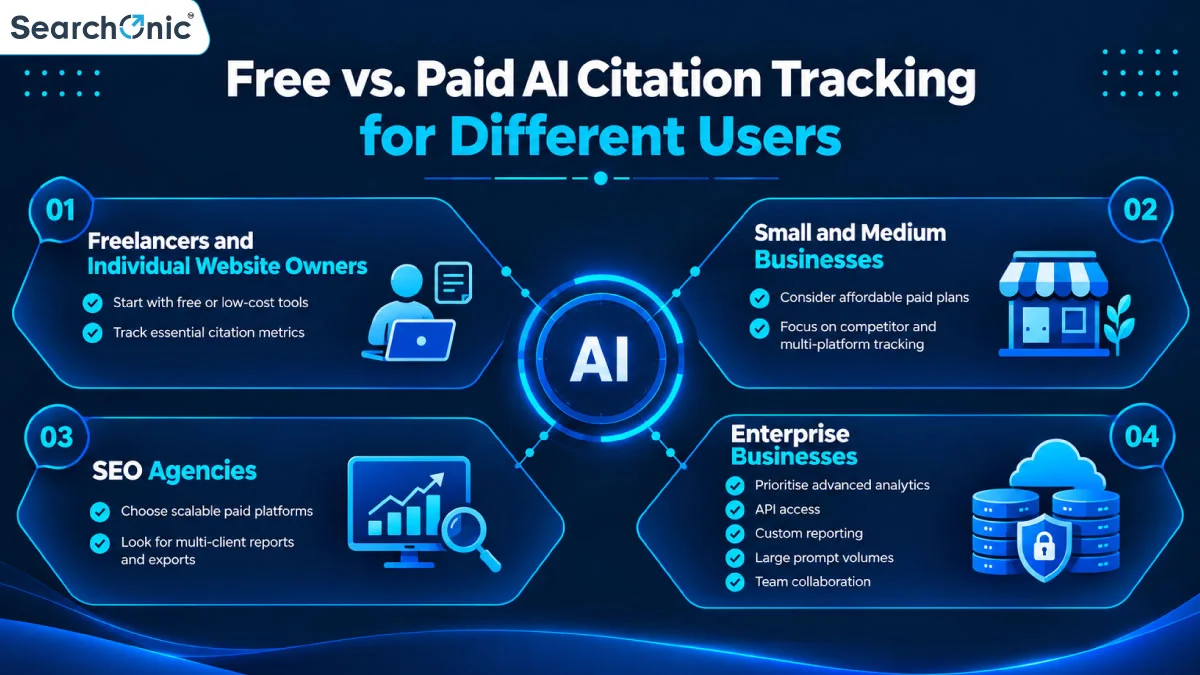
- Free vs. Paid AI Citation Tracking for Different Users
- ◈ Freelancers and Individual Website Owners
- ◈ Small and Medium Businesses
- ◈ SEO Agencies
- ◈ Enterprise Businesses
- What Features Should You Look for in an AI Citation Tracking Tool?
- Free or Paid AI Citation Tracking: Which One Fits Your Needs?
- Ready to Improve Your Visibility Across AI Search?
People’s search habits are evolving at a fast pace. People are now asking chatbots such as ChatGPT, Perplexity, Gemini, and Google AI Overviews to provide direct answers rather than search results. This is why AI citations are becoming ever more relevant to successful aio service.
With AI search citation tracking tools, you can easily gauge mentions, citations, and recommendations as brands fight for visibility in the AI-generated responses. According to a 2025 Pew Research Center study, 88% of Google AI summaries cite three or more sources, highlighting the importance of AIO and AEO. There are free tools and paid tools depending on the budget, tracking requirement and need of features for businesses. This guide provides a comparison of both solutions to decide which one to use.
What Are AI Citation Tracking Tools?
AI citation tracking tools are software that tracks, measures, and reports on the frequency of your brand, domain, or specific URLs being cited by large language models (LLMs) or generative search engines.
AI citation tracking tools analyze conversational answers generated by AI as opposed to the static search engine results page (SERP) with fixed numerical positions. AI engines consolidate data from a variety of websites and provide it in real time. These tools determine if your content is used verbatim, cited in source footnotes, or mentioned within a conversation in different AI platforms.
Why Is AI Citation Tracking Important?
Using AI citation tracking tools will help your company understand how frequently and in which places your brand is being mentioned by AI platforms. Not only these tools are able to tell you exactly that, but also they help point out the pages, articles, and other pieces of content that have been cited and therefore, the things that your competitors are doing in their AIO campaigns, you might want to know.
On the other hand, by making use of these kinds of tools one can analyze brand visibility against competitors and also reveal content gaps that can be filled. You, as a company, can use these insights to strengthen your artificial intelligence optimization (AIO) and GEO) strategies, which result mainly in better content that is worth it to be mentioned by AI-generated answers.
What Are Free AI Citation Tracking Tools?
◈ What You Typically Get With Free Tools
AI citation tracking tools free of charge are easy to use to keep an eye on the frequency of a brand’s use in AI-generated responses without a paid subscription. Typically, they provide limited citation monitoring for a small set of prompts or keywords and focus on a single or two AI tools, like ChatGPT or Google AI Overviews. They also tend to offer basic dashboards displaying basic mention or citation data in most cases.
◈ Advantages of Free AI Citation Tracking Tools
The main benefit you get is not having to spend an extra penny which would definitely be good if you need to do this task and at the same time it is not something that will be a major problem or expense to your company. Also, these tools are great for understanding how and what AI search engines evaluate a website content and that will be of great help in developing the necessary skills for AI SEO. Besides, they are a great fit for freelance creators, bloggers, and micro-websites if that is what you would like.
◈ Limitations of Free AI Citation Tracking Tools
One big problem is that free tools usually come with a restriction of the number of keywords that you can monitor as well as a limit to the number of search prompts that you can run.
Also, you will not get competitor tracking if that is a feature you are looking for in this case. Plus, they offer only simple reporting functionalities. The other major issue with them is that there are no features such as the ability to manually monitor or generate reports and data exports. Thus, it follows that, companies that have very large campaigns or those interested in getting answer engine optimization services of the utmost quality, will sooner or later move to the best answer engine optimization services.
What Are Paid AI Citation Tracking Tools?
◈ What Paid Tools Typically Offer
Paid AI citation tracking tools provide sophistication, better AI monitoring on top platforms, higher limits on prompts, competitor tracking, historical data, and detailed reporting. They’re meant for companies that require accurate and scalable insights into AI visibility.
◈ Advantages of Paid AI Citation Tracking Tools
Paid tooling gives access to more detailed data about which citations exist, as well as the analysis of such, competitor insights, automated monitoring, professional reports, and data exports. In addition, it can support larger-scale AI search campaigns.
◈ Potential Drawbacks of Paid Tools
On the other hand, the downside of paid software would be mainly that it is usually the case you have to pay a recurring subscription that means your expense might add up over time. Another problem would be that your business might get charged for some features you don’t really need, especially if your business is quite small. You can also experience higher costs once you go for a higher volume of prompts, get more users, or extend tracking to new areas.
Also Read: Top 15 AI Search Visibility Tools to Track Your Brand in AI Results
When Should You Choose a Free AI Citation Tracking Tool?
◈ Free Tools May Be Enough If You:
If your business has a limited number of core brand queries that are easy to monitor then a basic AI citation tracking tool should be sufficient for your needs. For example it would be okay to use one for small local websites and early-stage startups or for monitoring one brand’s presence within a few AI platforms.
They come in handy when you only want to manually check things sometimes or don’t have enough funds for a new search engine optimization tool. By using one of the free tools you’ll actually get a chance to test whether the AI visibility concept works for you before you finally commit.
When Should You Invest in a Paid AI Citation Tracking Tool?
◈ Paid Tools Make More Sense If You:
Businesses that have to deal with many clients, manage large websites, or are running extensive search campaigns with an AI model would do well by using paid AI tools for citation tracking. They are able to monitor all platforms simultaneously and also keep an eye on hundreds or even thousands of prompts from the industry.
These paid tools can also be a good option for businesses working with AEO strategy consulting who need competitor citations benchmarking or want to know their data through time to understand the performance and ROI measurement.
Free vs. Paid AI Citation Tracking for Different Users
◈ Freelancers and Individual Website Owners
Freelancers running their own site can opt for AI citation tools that are either completely free, or very affordable. You could use AI citation tracking as a free tool to monitor direct brand references and core product queries so that you have an idea of the kind of AI-related search presence your company can generate at first glance.
◈ Small and Medium Businesses
Micro, small and medium-sized (MSM) growing businesses that are going out into the real competitive market would need to go with the cheapest paid levels. AIO services and best answer engine optimization services are part and parcel of top brands’ AI citation monitoring efforts to keep their market share safe and their positioning up to standard through competitor surveillance.
◈ SEO Agencies
For agencies that offer AIO services, enterprise-grade paid tracking platforms are a must-have. Clients want clear reporting, multi-platform coverage and source analysis. Combine powerful software with expert AEO strategy consulting and agencies can provide clear, measurable ROI.
◈ Enterprise Businesses
Enterprises and corporations require advanced AI citation tracking platforms that have API integration, a facility to support multiple authors/users working together, features like the ability to run deep historical analysis. As it is an industry where the demand is very high, big businesses rely on AIO specialists in general and a good answer engine optimization company in particular for doing large-scale tracking, developing content strategies worldwide, and other related activities.
Also Read: Top 12 AEO Companies in India for Better AI Search Visibility
What Features Should You Look for in an AI Citation Tracking Tool?
Picking the correct AI search citation tracking tools means going for the ones which monitor major AI search engines and provide accurate visibility information. One way to go about it is to get ChatGPT citation tracking, do monitoring on Google AI Overview, perform Gemini visibility tracking, and track Perplexity citations monitoring at the same time. It would also be wise to get tracking mentions and the sentiment of your brand to know your business reputation from different angles via AI platforms.
Free or Paid AI Citation Tracking: Which One Fits Your Needs?
For businesses that want to experiment with AI search visibility, handle manageable projects, or conduct periodic audits, free tools can be a suitable option. In such cases, if continuous monitoring, competitor tracking, detailed reporting and a greater number of prompts are deemed to be important, then paid tools would be better suited. Before choosing, think about budget, marketing objectives, platforms you’re targeting and reporting needs.
Ready to Improve Your Visibility Across AI Search?
Use AI search citation tracking tools to evaluate the visibility you’re currently seeing and where you’re lagging behind your competitors in terms of citations. Then, collaborate with seasoned AIO specialists or an answer engine optimization expert to refine content structure, expertise, and AI read ability.
Tune your content for clarity and organised information, and keep a close watch on performance through the top AI citation tracking tools for brands. Continuous monitoring and AEO strategy consulting can be valuable in maintaining and improving visibility in the ever-evolving landscape of AI search.
Key Takeaways
- Understand the importance of AI citation tracking: AI citation tracking tools help businesses monitor brand mentions, citations, and visibility across platforms like ChatGPT, Gemini, Perplexity, and Google AI Overviews.
- Choose free tools for basic tracking needs: Free AI citation tracking tools are ideal for freelancers, startups, and small websites with limited budgets and monitoring requirements.
- Invest in paid tools for advanced features: Paid AI citation tracking tools offer competitor analysis, multi-platform monitoring, historical data, automated tracking, and detailed reporting.
- Select tools based on business requirements: Consider your budget, business size, tracking volume, and reporting needs when choosing between free and paid AI citation tracking tools.
- Strengthen AI search visibility with the right strategy: Combine AI citation tracking with AIO, AEO, and GEO strategies to identify content gaps, monitor competitors, and improve brand visibility in AI-generated responses.

Mit Thakkar
CEO & Co-founder at Searchonic & Midas Touch Infotech. I help Businesses To Increase Traffic & Leads with the Help of SEO.
Add as a preferred source on Google
Ready to Take Your Brand to the Next Level?
Let's Connect