Common SEO Mistakes That Hurt Your Website Rankings
September 22, 2026 By Mit Thakkar
Summarize this blog post with:
Quick Summary
SEO mistakes can impact your website’s visibility, rankings, organic traffic, and overall user experience. Issues like poor keyword research, keyword stuffing, low-quality content, technical SEO errors, slow page speed, weak mobile optimization, and improper metadata can prevent search engines from understanding and ranking your website effectively.
Fixing these issues through regular SEO audits, content improvements, technical optimization, and a strong internal linking strategy helps build a healthier website. By avoiding common SEO mistakes and continuously improving your strategy, you can increase search visibility, attract relevant visitors, and create better opportunities for business growth.
- Key Takeaways
- What Are SEO Mistakes and Why Do They Impact Rankings?
- ✦ Understanding SEO Mistakes
- ✦ How SEO Mistakes Affect Your Website
- How to Identify and Fix SEO Mistakes on Your Website
- Ⅰ. Conduct an SEO Audit
- Ⅱ. Analyze Search Performance
- Ⅲ. Improve Content Quality
- Ⅳ. Continuously Monitor SEO Changes
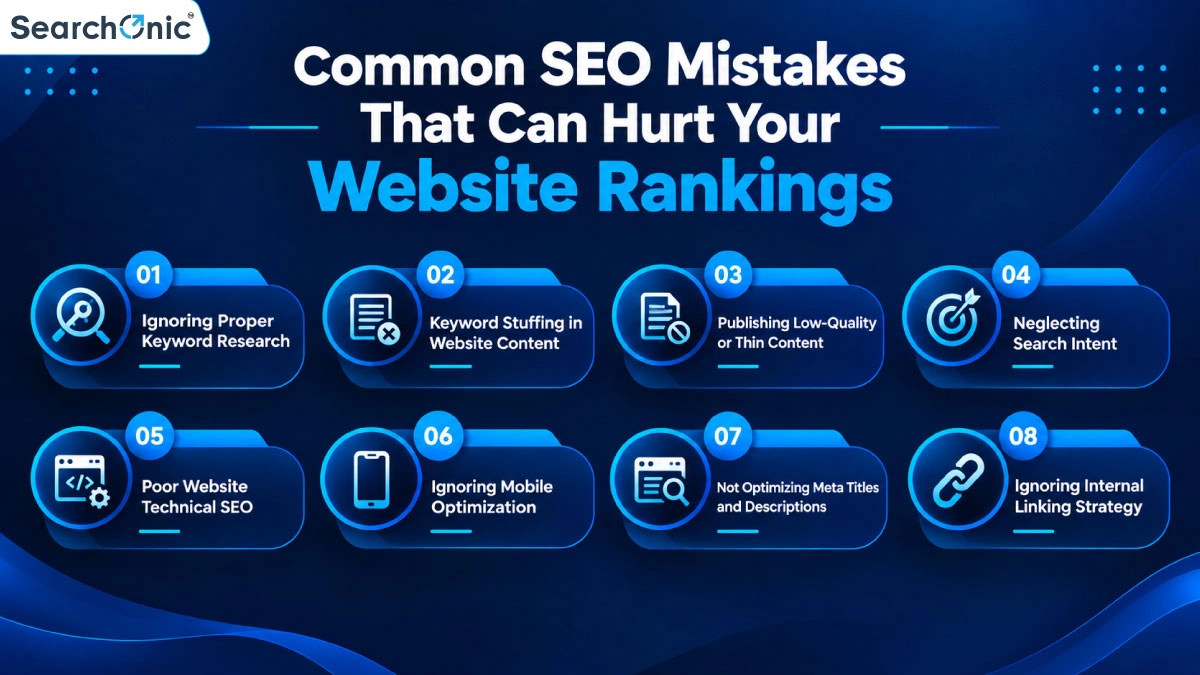
- Common SEO Mistakes That Can Hurt Your Website Rankings
- ◈ Ignoring Proper Keyword Research
- ◈ Keyword Stuffing in Website Content
- ◈ Publishing Low-Quality or Thin Content
- ◈ Neglecting Search Intent
- ◈ Poor Website Technical SEO
- ◈ Ignoring Mobile Optimization
- ◈ Not Optimizing Meta Titles and Descriptions
- ◈ Ignoring Internal Linking Strategy
- SEO Mistakes That Affect User Experience (UX)
- ✧ Slow Website Loading Speed
- ✧ Complicated Website Navigation
- ✧ Poor Content Formatting
- Ready to Improve Your Website Ranking with a Strong SEO Foundation?
Optimized websites are among the most effective strategies to expand online business. SEO improves the discoverability of your site by search engines, assists in attracting free organic traffic, and helps you to turn visitors into customers. While it’s great to use expert SEO consulting services to create a great strategy, there are many little mistakes that can do harm to a website, even if it’s small. If you have hidden problems, your website loses its ranking, users become disinterested and sales are lost. By steering clear of common SEO pitfalls, you can ensure that your website remains healthy and competitive.
What Are SEO Mistakes and Why Do They Impact Rankings?
✦ Understanding SEO Mistakes
SEO mistakes refers to any technical error, improper content strategy, or missing optimization that hinders search engines from crawling, understanding, indexing, or ranking a webpage. If a website loads slowly, its content is not clear, the links are broken, or the on page optimization is weak, it will be harder for search engines to understand a website and its value. These issues can become more complex when businesses face enterprise SEO mistakes across large websites with multiple pages and teams.
✦ How SEO Mistakes Affect Your Website
SEO errors may lead to lower search visibility and organic traffic by ranking pages lower in search results. They can also cause poor user experience due to slow, hard-to-navigate, and hard-to-read pages. A drop in traffic and engagement can lead to fewer leads and sales for websites and greater opportunities for competitors to reach the same audience. Businesses operating locally may also experience common local SEO mistakes that reduce their visibility among nearby customers.
How to Identify and Fix SEO Mistakes on Your Website
Ⅰ. Conduct an SEO Audit
Do an in-depth SEO audit to identify technical issues, content gaps, broken links and backlink issues. These issues can be identified by a seasoned SEO consultant who can suggest realistic solutions to enhance the functioning of the website.
Ⅱ. Analyze Search Performance
Analyze impressions, clicks, ranking and organic traffic to see how your pages rank in search results. The pages that are losing traffic can help you decide the area in which optimization is needed.
Ⅲ. Improve Content Quality
Keep information up to date and enhance pages where there is outdated or useful information, examples, and details that are accurate. Good content should not just meet the search intent, but also deliver value to readers. Avoiding common content SEO mistakes such as outdated information, weak structure and insufficient depth can help maintain content quality.
Ⅳ. Continuously Monitor SEO Changes
With the continuous evolution of search engines and user behaviour, you need to be monitored continuously by a SEO consulting firm. Monitor vital algorithm changes and make regular updates to website content, technical aspects and on-page optimization to keep the site visible.
Common SEO Mistakes That Can Hurt Your Website Rankings
◈ Ignoring Proper Keyword Research
➢ Why It Is a Problem
The wrong keywords can bring visitors who are not interested in products and services offered by your company. Not understanding search intent can also result in the creation of content that is not relevant to the target audience. This can lead to poor engagement, less conversions and wasted optimisation. SaaS businesses can face specific SaaS SEO mistakes when they target broad or irrelevant terms without considering product-focused search intent.
➢ How to Fix It
Generate keywords that reflect what users are searching for, and why they are searching for it. Stick to the relevant long-tails and then do some research on the pages that they are competing with, to find relevant keywords to tap that have the potential to benefit your business.
◈ Keyword Stuffing in Website Content
➢ Why It Is a Problem
Overusing keywords does not make it easy to read, and can make it look faulty. Overusing the same terms can lead to low-quality content and a bad user experience.
➢ How to Fix It
Write normally for readers and include primary keywords appropriately. Include appropriate synonyms, variants, and related words to enhance the content but not stuff it with keywords.
◈ Publishing Low-Quality or Thin Content
➢ Why It Is a Problem
The briefness or superficiality of the content may not lead to the presentation of sufficient useful information to answer a user’s query. Content on pages that aren’t in-depth, insightful, or informative may fail to meet user expectations and fail to achieve good rankings.
➢ How to Fix It
Develop informative, helpful and researched content that thoroughly covers the subject. Add relevant and accurate information, examples, practical tips and answers to common questions on older pages to make them stronger.
◈ Neglecting Search Intent
➢ Why It Is a Problem
When content doesn’t align with what the users are looking for in a search query, it may not keep them around. For instance, if a person is looking for a product they would likely expect a product or comparison page instead of a general informational article.
➢ How to Fix It
Understand the intent of the search query and develop content that addresses the intent. Analyze and understand the search results to see if users are looking for guides, product pages, comparisons, service pages or anything else.
◈ Poor Website Technical SEO
➢ Common Technical Issues
Slow web page speed, broken links, duplicate content, crawling problems, lack of XML sitemaps, and unclear URL structures can create difficulties for search engines to access and understand a website. These can also cause problems for visitors when navigating the site.
➢ How to Fix It
Regularly perform technical audits to find and fix these issues. Ensure that broken links are fixed, page speed is enhanced, indexing problems are addressed, canonical tags are used and XML sitemaps are updated to facilitate crawling and indexing.
◈ Ignoring Mobile Optimization
➢ Why It Is a Problem
If the mobile experience is poor, pages can be hard to read, navigate and interact with. With mobile-first indexing, websites that do not perform well on mobile devices can be affected by their poor mobile performance and could therefore not have a good search engine presence.
➢ How to Fix It
Apply Responsive Design & Optimise images for mobile loading. Test menus, buttons, forms, text and the layout of a page against various devices and screen sizes to ensure that the site is easy to use.
◈ Not Optimizing Meta Titles and Descriptions
➢ Why It Is a Problem
An unclear or poorly worded meta title and description can result in search results that are less useful and user-friendly. They offer a crucial hint of a page, and irrelevant or poor metadata could deter clicks from search results.
➢ How to Fix It
Write creative, meaningful and descriptive meta titles and descriptions for each significant page. Use main keywords sparingly with a clear message to what users can expect to find on the page. A SEO consulting agency can assist you to keep good metadata throughout the web site.
◈ Ignoring Internal Linking Strategy
➢ Why It Is a Problem
Internal linking can cause problems if it is poor, important pages may be hard to find and relationships between related content is not apparent. It can also make it hard for visitors to access further information that can enhance their search and purchase process.
➢ How to Fix It
Use anchor text for the links that are easy to understand and make sense in the context of the webpage. Create logical connections between relevant articles, service pages, product pages, and other important pages. A well thought out internal linking structure assists both the user and makes it easier for them to find related content on the website.
Also Read: SEO for IT Companies India: Complete Guide for 2026
SEO Mistakes That Affect User Experience (UX)
User experience and search optimization go hand-in-hand. If they like your site, then your search engine performance will be rewarded.
✧ Slow Website Loading Speed
Users will click away if the pages take more than a few seconds to load. Slow speed is detrimental to engagement, decreases conversions, and negatively impacts Core Web Vitals.
✧ Complicated Website Navigation
Ambiguous menus make it difficult to locate items on the menu. Having disorganized navigation is not only a challenge for your visitors, but also for the search engine crawlers to find all of your main pages. A local SEO mistake such as inconsistent business information or poor location signals can also make it harder for local customers to find relevant pages.
✧ Poor Content Formatting
The pages contain large stretches of plain text, which makes them hard to read. Visitors move away before they locate the answers when there are no subheadings, short paragraphs or visuals.
Ready to Improve Your Website Ranking with a Strong SEO Foundation?
SEO is an ongoing process of testing, measuring and optimisation. If you don’t address common SEO mistakes, you may lose visibility, organic traffic and growth opportunities on search engines. The solution to these problems provides a better base for future search experience. Regularly optimising your website and monitoring its performance can help improve your site strategy and ensure website growth is consistent over time, all of which can be done with a trusted SEO consulting company.
Key Takeaways
- Identify Common SEO Mistakes: Understanding issues like poor keyword research, thin content, technical errors, and weak optimization helps businesses protect their search rankings.
- Improve Website Performance: Regular SEO audits help find and fix problems related to page speed, mobile experience, crawling, indexing, and overall website health.
- Create High-Quality Content: Developing useful, search-intent-focused content helps attract the right audience and improve organic visibility.
- Strengthen Technical SEO: Optimizing website structure, internal links, metadata, URLs, and other technical elements supports better search engine understanding.
- Build a Long-Term SEO Strategy: Continuous monitoring, optimization, and expert guidance help businesses maintain rankings and achieve sustainable online growth.

Mit Thakkar
CEO & Co-founder at Searchonic & Midas Touch Infotech. I help Businesses To Increase Traffic & Leads with the Help of SEO.
Add as a preferred source on Google
Ready to Take Your Brand to the Next Level?
Let's Connect