Enterprise SEO Strategy: 12 Best Practices for Large-Scale Websites
August 31, 2026 By Mit Thakkar
Large websites have the problem of large SEO efforts involving thousands of pages, big content archives, many teams working on the site, and frequent content changes. Sound enterprise SEO services can handle the large size and at the same time boost visibility, traffic, leads, and revenue.
Enterprises that are serious about SEO will use an enterprise SEO strategy as a base for managing their online presence. These enterprise SEO activities include the use of automation tools, technical SEO optimisation, data management, and coordination across departments. According to recent industry data, 82% of enterprise SEO specialists plan to increase their investment in AI, highlighting the growing role of automation and data-driven technologies in managing SEO at scale. In the meantime, enterprise SEO services help companies develop scalable processes, whereas enterprise SEO strategy 2026 brings together technical SEO, content, keywords, and your business strategies.
Why Large Websites Need a Dedicated SEO Strategy
Large websites rely on specialist SEO strategies in their planning since even minor things can have an impact on a huge number of pages. In addition to complicated site structures, they also manage different product and content teams, work with large data sets, and face frequent updates of their technical or content elements. Without having well-defined procedures, changes of this sort lead to SEO issues quite quickly.
A small error in a URL structure, website template, a canonical tag, or internal linking can affect the whole site at the same time. An enterprise-level SEO strategy offers you a methodical approach to finding and solving problems of this nature and at the same time ensuring that SEO efforts remain consistent across the website.
What an Effective Enterprise SEO Strategy Should Achieve
Your enterprise SEO strategy should aim at enhancing the website’s organic visibility, achieving higher search engine rankings, driving more targeted traffic, increasing conversions, generating revenue, and making the website easily searchable and indexable. Also, it should lay the ground for SEO that can grow with the size of your website over time.
It is, however, more than just adding a bunch of SEO techniques to the website.
Modern enterprise SEO strategies involve understanding the customer base, improving website experience, and creating growth strategies from which your team will benefit. You can look for help from a professional enterprise SEO services provider, as they are trained in assisting with technical SEO work, producing the right content for your business, and improving the overall performance of the site.
What You’ll Learn in This Guide
In this post are the 12 most practical ways to boost your SEO for large websites. We will show you how enterprise companies can efficiently carry out SEO processes, get all their departments to cooperate, leverage technology, as well as how to evaluate performance. These powerful expert enterprise SEO strategies are what can create an SEO base that is both strong and easy to manage.
How to Build an Enterprise SEO Strategy
⮩ Start With a Complete SEO Audit
The first step should always be a deep technical review of the site that also includes indexing issues, website redirects, page load speed, duplicate content, internal linking, backlinks, quality content, and keywords. A full-scale SEO audit done by enterprise SEO specialists is capable of spotting issues in hundreds or thousands of webpages that could impact on SEO negatively.
⮩ Set Clear SEO Goals and Priorities
Setting SEO objectives for organic traffic, ranks, leads, conversions, visibility, and revenue can really help. The ranking of priorities among the issues must be based on the level of the impact of these issues on the business. It is an established fact that enterprise SEO optimization services will enable a company to target its limited resources on those areas which can yield the highest returns from business growth.
⮩ Create a Scalable SEO Framework
We can set up the standard way for doing SEO on a technical level, creating content, selecting the right keywords, making internal links, setting up redirects, metadata, etc. These standardized systems are absolutely essential ingredients for a great enterprise-level SEO strategy since through them teams can handle large-scale pages.
⮩ Align SEO Across Business Teams
To get optimum performance from your SEO strategy, you will need your development and marketing teams to have SEO considerations in their minds when making decisions. This is why clear lines of communication and defining who will be responsible for what can really contribute to eliminating a lot of SEO headaches in website redesigns and major overhauls. The top enterprise SEO services can help you establish and improve that cross-functional cooperation.
⮩ Use Data to Guide SEO Decisions
Take insights from rankings, traffic, conversions, crawls, and other business data to determine what works and where you can get better. An experienced enterprise SEO strategy consultant will be able to take in huge sets of data and show you the SEO priorities.
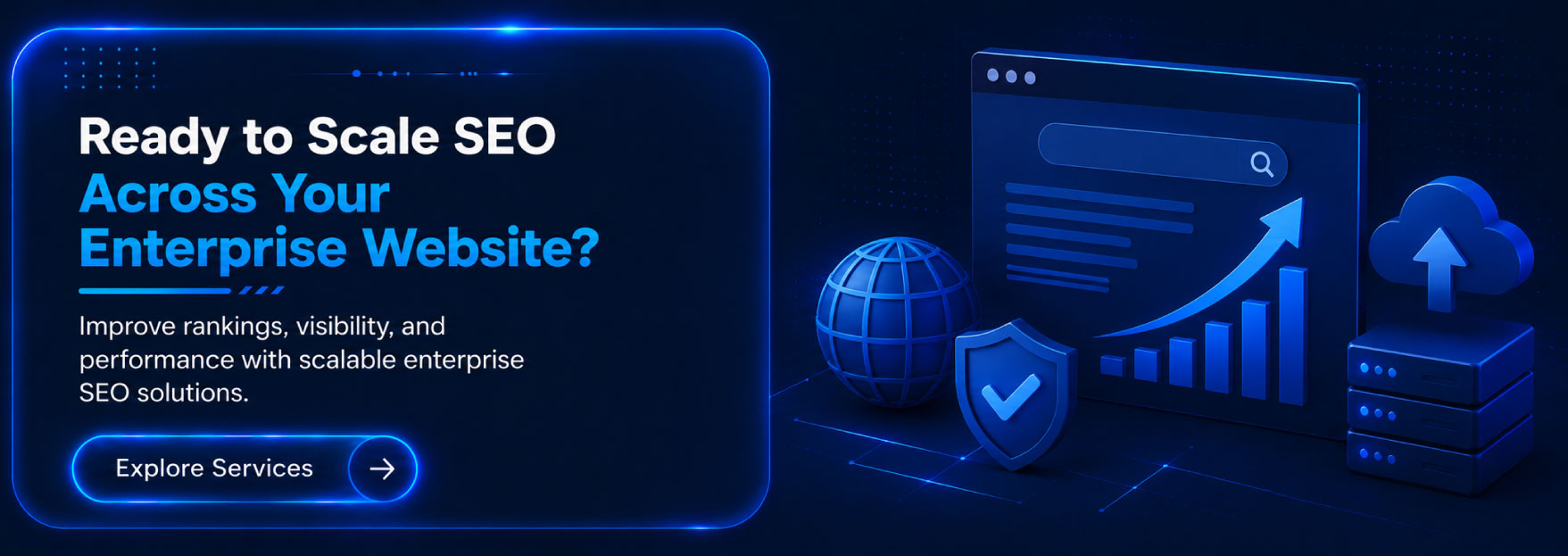
12 Best Practices for Enterprise SEO
1. Scale Site Architecture
✦ Build Clear Site Structure
A well-defined site structure assists users and search engines in comprehending the structure of a big website. Organize related products, services, and content into logical sections, but remain accessible to important pages, using navigation and internal links. An organized structure makes it easier to use and assists in corporate enterprise SEO services.
✦ Create SEO-Friendly URLs
Clean URLs help large sites become easy to understand and manage. Make URLs short, descriptive, simple, and page-specific. Don’t have duplicate URLs that contain different or similar content, as this can cause confusion to search engines as well as make site management more difficult.
2. Centralize Keyword Research
Large teams can ensure that departments are all targeting the same keywords by using keyword research in a centralized way. It establishes a common strategy for choosing keywords and minimizes the chances of multiple teams targeting the same keywords with multiple pages.
✦ Build Keyword Maps
Identify keywords that match the user’s search intent, are relevant, have low competition, and are of good business value. Then, identify primary and secondary keywords for relevant pages according to their functions. A good keyword map makes it easy for teams to develop targeted content and minimize overlap between content on large websites.
✦ Prevent Keyword Cannibalization
Examine similar keyword pages and look for pages in unneeded competition. When the purpose of the two pages is the same, they can be merged; When the purpose is different, the search target on the page should be clear. This helps in implementing expert enterprise SEO strategies and helps in developing a more structured keyword organization.
3. Strengthen Technical SEO
For large websites, technical SEO is crucial since a single problem might impact multiple pages. Regular monitoring will allow teams to catch issues such as website crawling, indexing, redirects, website performance, and accessibility problems that can lead to bigger SEO issues.
✦ Improve Crawling
Look for and correct broken links, server issues, redirect problems, and blocked resources that can hinder search engines from being able to reach pages. Ensure that XML sitemaps are kept accurate and up-to-date so that key URLs can be easily found. For enterprise SEO services, regular crawling checks are crucial.
✦ Boost Site Performance
Track and enhance Core Web Vitals metrics and other metrics impacting page experience and loading speed. Optimize large resources, enhance server performance, and delete unused scripts if possible. A swift web page could offer you a better experience and aid in greater technical SEO.
Also Read : 15 Best Enterprise SEO Tools for Enterprise Websites in 2026
4. Improve Internal Linking
Internal linking will assist search engines in finding key pages and in recognizing relationships between various topics. It also provides users with more obvious links to related content, services, products, and related information on a large website.
✦ Connect Relevant Pages
Link related pages, category pages, products, and services together by linking through relevant internal links. Don’t use ambiguous or nonsensical anchor text. A well-developed internal linking strategy enables the sharing of authority across the site and serves as a better way for users and search engines to locate important pages.
✦ Fix Orphan Pages
Find pages that have few or no useful internal links by using crawlers and analytics. Check their relevance and link them up with appropriate pages of the site. Orphan pages do not help people find your website and make your site less connected.
5. Manage Content Quality
It is possible for huge websites to get stale, duplicated, and low-value content very easily. Content reviews can also be done regularly to keep businesses with useful pages, minimize duplication, and ensure the content published continues to match user needs and search intent.
✦ Fix Duplicate Content
Recognize and distinguish between pages of identical and/or very similar content and understand when this similarity should be consolidated, enhanced, or maintained. If relevant, choose the preferred URL by using canonical tags. This lowers duplication and facilitates uniform company enterprise search engine optimization services.
✦ Improve Thin Content
Review pages that have insufficient information or don’t meet search intent. Add useful details, examples, and relevant information where possible. To ensure content quality, pages that are no longer useful can be updated, redirected, consolidated, and removed.
6. Scale Content Strategy
Many enterprise websites have multiple teams publishing a lot of content. A solid content strategy fosters high-quality content, while ensuring each page has a purpose and contributes to the broader SEO and business objectives.
✦ Match Search Intent
Develop content that meets the intent of the query. Address various phases of the search experience such as awareness, research, comparison, and purchase. Matching intent attracts visitors that matter, and can help businesses produce meaningful content.
✦ Standardize Content
Provide clear direction to writers with SEO content briefs, including keywords, search intent, topics, links, and page goals. The standards of content accuracy, tone, content formatting, and optimization should also be consistent for editorial guidelines. This makes modern enterprise SEO strategies more easily scalable.
7. Optimize Global SEO
Any business running in several countries must have a method for international SEO. Regional pages, language versions, local keywords, and technical signals should complement each other to provide target-specific content to targeted users.
✦ Structure Global Pages
Consistently structure country/language versions of pages. Clearly organize your regional / translated versions to be understood by the search engine. A logical international structure also facilitates the management and growth of large websites.
✦ Localize Global Content
Make proper use of hreflang and determine appropriate language and regional alternatives. Look for keywords in your area rather than transposing the entire question, and fine-tune material for local tastes. Global optimization is a crucial aspect of top enterprise SEO services for global businesses.
8. Use Structured Data
Web pages can include structured data to aid search engines in comprehending the importance of the information on the page. If your site is large, you can make structured data more manageable and minimize discrepancies on thousands of pages by using consistent implementation on suitable templates.
✦ Add Schema Markup
Select the types of schema that are appropriate for each page and be consistent with them throughout relevant templates. Update structured data whenever templates and/or content change. Properly marked-up information provides search engines with a greater understanding of the site’s information.
✦ Monitor Rich Results
To find validation mistakes and make sure structured data is implemented correctly, test it often. Track eligible pages and search functions to determine if markup is helping to improve visibility. An ongoing audit can be used to keep the structured data quality in place as the site expands.
9. Strengthen SEO Governance
It’s important for large organizations to have clear SEO ownership as there are numerous teams that can impact website performance. With good governance, processes are clear, and the SEO factors are taken into account with content, development, design, and marketing activities.
✦ Assign SEO Ownership
Establish clear roles for technical SEO, content, development, analytics, and reporting. Build workflows to facilitate team coordination of changes and to carry out significant SEO activities. An expert enterprise SEO consultant can also assist in prioritizing the various departments.
✦ Create SEO Standards
Outline SEO best practices for URLs, metadata, redirects, links, indexing, content, and technical updates. Embed SEO testing into the publishing and development process to identify issues early in the process. Understanding that there are standards makes it easier to manage enterprise SEO at large scale.
10. Automate SEO Reporting
Reports are time-consuming on large sites, and SEO data is generated quite a bit. Automation can assist teams in keeping track of key metrics and make it easy for them to get a head start on any changes that need to be made without having to manually review each page or report.
✦ Automate SEO Checks
Automated systems for technical error monitoring, indexing changes, broken links, redirects, and other critical concerns. Automated checks can detect issues earlier instead of them impacting vast chunks of the website, and enable teams to take care of them before they become a concern.
✦ Build SEO Dashboards
Build dashboards that consolidate traffic, rankings, visibility, conversions, and revenue. When you can analyze your SEO metrics against your business results, it becomes more convenient to understand the performance. Your decision-making process will be quicker, and scalable enterprise SEO strategies will involve automation.
11. Build Quality Links
In the case of large websites, it is important to obtain relevant and trustworthy backlinks instead of numerous low-quality links. A quality-centered strategy can enhance authority, help to support helpful content and valuable resources.
✦ Earn Editorial Links
Develop original research, surveys, statistics, studies, guides, and useful resources that other websites may want to reference. Great content will earn relevant editorial links organically, and build up the site’s authority in its niche.
✦ Monitor Backlinks
Monitor new domains and lost referring traffic, as well as audit backlink quality regularly. Monitoring allows for the detection of any unusual changes and ensures a healthy link profile. Experienced enterprise SEO companies can combine link earning with content promotion and digital PR activities.
12. Measure SEO Growth
Monitoring is essential to SEO to track performance and uncover new opportunities. Regular reviews allow businesses to link any organic search interest with actual results like traffic, leads, conversions, and sales.
✦ Track SEO KPIs
Track organic traffic for significant pages, categories, markets, and devices. Make sense of the value of organic traffic to the business by tracking conversions, leads, and revenue. Having clear KPIs allows teams to track progress and gives them a clear indication of what still needs to be done.
✦ Optimize SEO Performance
Determine pages, keywords, markets, and content areas to expand. Improve tests and see their effect; learn from the results and make decisions accordingly. Ongoing optimization plays a role in fortifying enterprise SEO strategy 2026 and fostering sustainable search growth.
Enterprise SEO Implementation Roadmap
◈ Phase 1: Audit
Dig deep into what is currently going on with the website, such as the technical aspects, a look at the quality of the content, keyword selection, internal linking structure, and performance as a competitor. An audit report highlights the problems that still exist, the opportunities that you have not used, and the points of action that will have to be dealt with right away and before any other SEO work starts.
◈ Phase 2: Prioritize
Detect the big-ticket issues and rate them by considering how big their impact is to the company in terms of revenue, the technical challenge required, the resources one has to play with, and the expected result. An enterprise SEO consultant can assist the teams to understand which issues should be handled first and agree on responsibilities, as well as setting realistic timeframes.
◈ Phase 3: Implement
The work of fixing what is not done technically correctly, the work of the architecture improvement, and the work on content are all the things that can be counted as a part of SEO. It is also necessary to check links to all pages within the site thoroughly. Finally, the use of automation can be beneficial. Having enterprise SEO strategies laid down for the whole organization will help various teams follow the same standards and be assured that the SEO improvements are going the right way through the site.
◈ Phase 4: Measure
Track changes in rankings, organic traffic, conversions, and, of course, the technical health of a site following the SEO changes. Periodic performance reports can help enterprise SEO companies see if the new methods they’ve adopted lead to a noticeable enhancement or not and find the areas that may need a little more effort.
◈ Phase 5: Scale
Repetitive SEO tasks are a thing of the past thanks to automation. Besides, there are strategies that work best when you just do it more and more. Furthermore, there is a possibility to have the management process involving SEO work being a shared responsibility throughout a company. Also, continuous improvement is the way to go with website performance. As they say, at the end of the day, enterprises that get expert guidance when it comes to enterprise SEO strategies would be the ones that will not only replicate but also expand the successes across new markets, new products, new content areas, and even larger parts of a website.
Also Read : SEO for IT Companies India: Complete Guide for 2026
Enterprise SEO Tools and Technology
➣ Technical SEO Tools
In order to carry out SEO at scale, teams of SEOs would use various technical tools such as search engine crawlers, log-file analysis platforms, site performance monitoring systems, etc. These tools help to monitor a huge number of web pages and spot technical issues.
➣ Keyword and Content Tools
Such keyword research platforms, content optimization tools, as well as competitor analysis tools are essential elements for SEO. Teams have the freedom to do keyword planning centrally with a consistent approach; content opportunities will always be identified, and SEO optimization work across large websites and multiple content teams will be supported at the same time.
➣ Analytics and Reporting
SEO success can be evaluated with data analytics platforms that allow organic traffic, ranking, revenue tracking, etc. With the use of search performance tools combined with business intelligence dashboards, enterprise SEO consultants can make search results accountable. Finding the areas where the business has to improve is another benefit of reporting.
➣ Automation
SEO APIs, custom scripts, automated monitoring, and reporting workflows can help eliminate the need for repetitive and tedious activities related to enterprise-level web operations. With automation, the enterprise SEO team can spot technical or performance issues more timely, streamline their reporting, and leave their time for other more important SEO activities.
Ready to Scale Your Enterprise SEO Strategy?
Big websites call for more than a few SEO tweaks. What they really need is a structured way of managing technical SEO, content, keywords, internal links, data, and company objectives. A best enterprise SEO company will offer SEO services that can be adapted to your company’s size and needs and help you gain visibility, increase traffic, generate leads, and close sales.
Audit SEO gaps first, then make an action plan for addressing the high-impact items, keep a close eye on your main performance metrics, and make a point of constantly improving. A seasoned enterprise SEO agency, or perhaps specialized enterprise SEO companies or a top enterprise SEO strategy consultant, can provide high-level enterprise SEO services and corporate enterprise SEO services by applying the latest enterprise SEO strategies for your business.

Mit Thakkar
CEO & Co-founder at Searchonic & Midas Touch Infotech. I help Businesses To Increase Traffic & Leads with the Help of SEO.
Ready to Take Your Brand to the Next Level?
Let's Connect