7 Different Types of Pitch Decks and When to Use Them
August 18, 2026 By Mit Thakkar
Summarize this blog post with:
- What Is a Pitch Deck?
- Why Choosing the Right Pitch Deck Matters
- ✦ Aligning Your Deck with Your Goal
- ✦ Understanding Your Audience
- ✦ Making Your Message More Effective
- What Should Every Pitch Deck Include?
- ⮩ A Clear Problem and Solution
- ⮩ Market and Competitive Information
- ⮩ Business and Financial Information
- ⮩ A Strong Call to Action
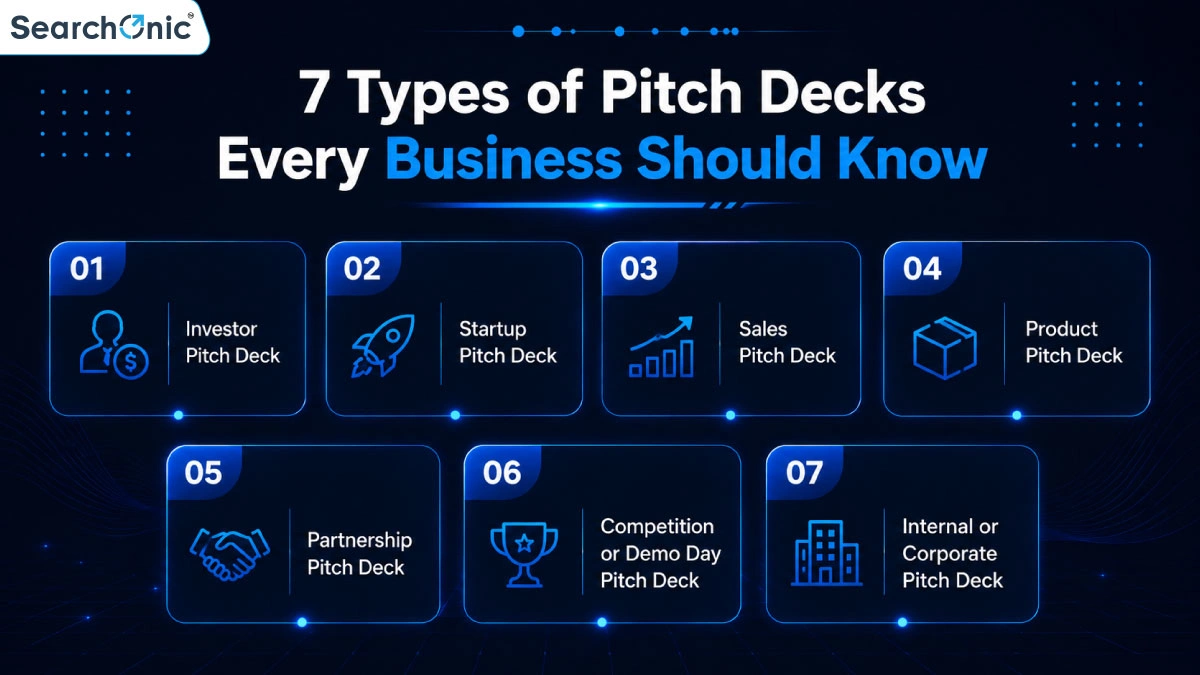
- 7 Types of Pitch Decks Every Business Should Know
- 1. Investor Pitch Deck
- 2. Startup Pitch Deck
- 3. Sales Pitch Deck
- 4. Product Pitch Deck
- 5. Partnership Pitch Deck
- 6. Competition or Demo Day Pitch Deck
- 7. Internal or Corporate Pitch Deck
- How to Choose the Right Pitch Deck
- ➣ Start With Your Objective
- ➣ Identify Your Audience
- ➣ Match Your Content to the Audience
- ➣ Keep the Story Focused
- Key Elements of a Successful Pitch Deck
- ⇒ Compelling Storytelling
- ⇒ Strong Visual Design
- ⇒ Data and Evidence
- ⇒ Clear Call to Action
- Common Pitch Deck Mistakes to Avoid
- Choose the Right Pitch Deck to Turn Your Idea into Opportunity
A pitch deck is more than a collection of eye-catching slides. Understanding the different types of pitch decks helps you present your business idea, product, service, or opportunity clearly and persuasively to the right audience. Professional pitch deck designers using the best pitch deck structure can simplify complex data into a compelling and convincing story. Research shows that only 58% of pitch decks are viewed to completion, highlighting the importance of clear storytelling, strong visuals, and a well-structured presentation to keep investors engaged.
As each viewer comes with their own expectations, choosing the right types of pitch deck is important. Buyers, partners, internal teams, and investors may all require various things at different periods. Below, we have described various kinds of pitch decks along with situations when you could use them, as well as the way in which the appropriate pitch deck structure and pitch deck design service could assist you in making the presentation more impactful and efficient.
What Is a Pitch Deck?
A pitch deck is an oral short presentation that is a visual depiction of an idea for a business or a product or a solution or an opportunity. Usually, they include not just text but also visuals, graphs & charts in addition to other kinds of materials that an audience can use to quickly and accurately grasp the core message.
Businesses rely on pitch deck design services to achieve a number of objectives such as fundraising, sales, getting partners, launching new products, getting awards, or doing internal presentations. An excellent pitch deck will show the right amount of information but will not overwhelm viewers with so much that they become lost in the details.
Contrary to a business plan, a pitch deck tends to be more compact and visual. While a business plan generally gives you all sorts of details on operations, finance, planning, and other areas, a pitch deck is primarily for grabbing attention, sparking interest, and prompting people to take action from there.
It is a factor in a well-structured pitch deck. Working with an expert pitch deck agency is definitely a good way of getting help to lay out the story so that each slide is meaningful.
Why Choosing the Right Pitch Deck Matters
✦ Aligning Your Deck with Your Goal
One needs to keep in mind what one wants to communicate in addition to what style, format, and design would best convey that message. If you are making an investor pitch, it will largely consist of elements such as market potential, projected growth, and financial forecasts, while if you are selling your product, the content will likely be customer issues, product perks, and outcomes. By picking suitable pitch deck types, you are basically making sure the story is told so that the main point is made clearly and the audience will not be distracted by unimportant things.
✦ Understanding Your Audience
The expectations and priorities of the target viewers vary. Investors want to know about the growth potential, the size of the market, and the returns they can possibly get. It’s likely that prospective clients may inquire about how the good or service will satisfy their wants. Whereas potential partners may focus on shared goals and business benefits they’ll gain. Knowing how the different categories of audiences will view things enables you to come up with a presentation that makes sense, adds value, and is easy to follow.
✦ Making Your Message More Effective
With proper choice, your pitch deck is stripped of the irrelevant and only the message remains. The presentation gets to its point through a series of slides, each of which should reinforce the main point and at the same time allow the audience to see the value of whatever you are pitching. Besides, getting in touch with seasoned pitch deck design agencies can assist you in the improvement of slide layout, visual effects, wording of the content, and finally the whole quality of the presentation. The end result is a professionally prepared and very persuasive pitch deck.
What Should Every Pitch Deck Include?
⮩ A Clear Problem and Solution
The best pitch deck structure needs to describe the problem, the group of people who are having difficulties, and the reasons behind the problem quite thoroughly. Afterward, the business should clearly explain its solution to the problem and what feature distinguishes it from its competitors. It is always helpful to the listeners if you start with a simple, logical sequence of presenting the problem first, then the solution, because this gives clarity of the subject very rapidly.
⮩ Market and Competitive Information
Every business pitch should provide a clear view of its target audience, market opportunity, industry trends, and competitors. Describe the company’s unique selling points and the reasons why clients might pick it over alternatives. Reliable market data can also make the opportunity more credible and help support key claims.
⮩ Business and Financial Information
The pitch deck should contain relevant information like the business model, profits, growth strategies, financial outlook, and capital requirements of the company when necessary.
A seasoned pitch deck expert can assist you in choosing the most useful graphics and numbers as well as conveying them clearly. It is better to show the potential and strength of the business by means of the numbers rather than having your slide pages filled with superfluous financials.
⮩ A Strong Call to Action
The last step in a business pitch is to tell the audience specifically what you need from them. This may be raising capital, setting up a meeting regarding sales, finding out about a partnership, giving your approval for the project, or even arranging the demonstration of a product. Picking out precisely the action for the audience can make it easier for the audience members to realize what their job is from that moment on.
Also Read : Top 7 Pitch Deck Design Agencies in Dubai (Edition 2026)
7 Types of Pitch Decks Every Business Should Know
1. Investor Pitch Deck
◈ Purpose and Audience
An investor pitch is an investor presentation with the idea of securing financial backing. That will be Angel investors and venture capital companies; these are the main fund-raiser types you can get money from besides other sources. It also has to communicate how a company would grow, what the potential market for a product is, who the main customer is, and it has to even be argued why it is a company you should bet money on. All the necessary facts are covered in a presentation, enabling it to communicate quickly and effectively with the investor about the company and their expectations.
◈ Key Information to Include
An investor deck would typically have slides dealing with a problem, solution, opportunity, size of market, a business model, and so on. It is a very frequently used type of pitch presentation by companies that are seeking funds. One could get help from a pitch deck design agency to make the slides convey the complex figures and market information in a simple and easy way.
2. Startup Pitch Deck
◈ When to Use It
A startup pitch deck can serve many occasions, including investors, accelerators, incubators, mentors, and also partners of a small startup business. This type of presentation is especially useful for startups at a very early stage, who might not have a significant income yet but are backed by a promising idea, a market segment, or a growth plan. The presentation needs to explain that the startup is solving a particular issue, how, and why the solution is worth investing in.
◈ Essential Slides
An investor presentation is a pitch deck that a startup uses to present its business idea in an attractive and convincing way. Pitch deck templates can provide a useful starting point, but businesses searching for the best pitch deck templates 2026 should choose layouts that can be customized to match their startup goals, brand, and audience. Well-designed pitch deck templates are a good reference but should not limit the presentation so that the content and visuals are compatible with the startup’s goals and brand.
3. Sales Pitch Deck
◈ Target Customer and Pain Points
The sales pitch deck is a means of attracting prospective customers and getting them to consider a product or service. Compared with an investor presentation, a sales pitch deck does not delve too much into investment potential but rather into customer problems, needs, and benefits that come to mind. Hence, explaining the challenge faced by the potential target customer and then how the offering can be a solution to the problem should be the main content of the sales pitch deck.
◈ Product Benefits and Value
The sales presentation can mention how the product will add to the customer’s life through its benefits, what the results will look like with the use of the product, the customer’s pricing, how to make a customer feel successful by showing a couple of success stories together with the customer’s testimonials, and how they can do an actual test with the customer through some case studies.
Instead of enumerating features the customer should know, the presentation should emphasize how the features bring value to the customer. By using a professional service for pitch deck design, the complex product features that customers would receive through their orders can easily be transformed into an appealing and easily understood sales presentation, which is customer-oriented and accompanies the sales conversation.
4. Product Pitch Deck
◈ Product Overview and Features
Such decks are usually the pitch decks that introduce new products. They explain their functionalities, the ways in which they operate, and the reasons customers would need them. They may be helpful for launching products, demonstrating, giving investor meetings, getting internal approvals, or presenting to customers.
A presentation should enable the product to be clearly grasped at one glance if it includes the technical and complicated features in general. Visuals such as product images, screenshots, diagrams, and demonstrations can be utilized to give a better understanding of the product and also show its effectiveness.
◈ Market Need and Competitive Edge
A product presentation should show how product features meet customer needs and clarify product differentiating factors from its competition. It also indicates a great demand for the product, main benefits, and the reasons for the success of the product. This pitch deck type is the best one among the different pitch deck types to present the product directly and explain the product clearly and convincingly.
5. Partnership Pitch Deck
◈ Partnership Opportunity
Partnership pitch decks are usually created by businesses that want to be partners with another firm, vendor, supplier, organization, or strategic colleague. The deck would clearly explain why the partnership would be feasible for both parties and what a combined opportunity they can pursue. It might include presenting the market opportunity, the target customers, the activities, the resources, and the expected results.
◈ Mutual Benefits and Goals
The pitch should be crystal clear that the joint venture of the parties will reap mutual benefits.
Covering topics such as the shared objectives, the target customers, the models of the partnership, the resources needed, the revenue streams, the promotional strategies, the timeline of implementation, and the actions after this partnership, a pitch deck agency will be able to develop a fair presentation to the parties that highlights the mutual benefits rather than only promoting one company’s perspective.
6. Competition or Demo Day Pitch Deck
◈ What Makes It Effective
Typically, competition and demo day decks are done in a short, timed period. As a result, they must be memorable, engaging, and have an impact. The opening should start the interest right away, and each succeeding slide should build on the main story. Unnecessary information should be eliminated to let the audience understand the idea without getting lost.
◈ Key Points to Highlight
This deck can be used to discuss the problem, solution, product demo, market opportunity, traction, competitive advantage, team, business model, and future plans. A presentation can be better remembered if it is done with good storytelling and good visual design. A pitch deck expert can help you make complex ideas simple, enhance the flow of the slides, and focus on the content that’s most relevant to your time-constrained presentation.
7. Internal or Corporate Pitch Deck
◈ Business Proposal and Objectives
The internal and corporate pitch deck is a tool for presenting new projects, products, campaigns, investments, process improvements, or strategic plans that take place within a company. Unlike external decks, such slides are usually produced for managers, executives, department heads, or internal decision-makers. They should describe the current state of affairs, the proposed idea, the anticipated benefits, resources required, and the implementation plan.
◈ Budget, ROI, and Next Steps
Decision-makers within an organization want facts, figures, and numbers. So the pitch deck needs to cover the budget, expected return, business impact, time, risks, resources, and metrics very clearly. Also, the deck has to explain how the new proposal can support business objectives and what the request or approval is for. Among the various types of pitches, the internal pitch deck typically places the most emphasis on day-to-day, tangible results, numbers, financial aspects, and clear decision-making.
How to Choose the Right Pitch Deck
➣ Start With Your Objective
A leading pitch deck design company can help align the presentation with its main purpose, whether the goal is fundraising, sales, partnerships, or internal approval. The purpose could be to raise capital, get the attention of clients, form partner relationships, put out new products, win competition, or get a green light for a new business idea internally. Clear objectives are the key to selecting the perfect pitch deck structure, content, theme, etc.
➣ Identify Your Audience
Determine the kind of audience that will be watching your presentation first. Think about what they might want to know as well. For instance, an investor will usually look for growth and returns, whereas a customer might want to see the product’s benefits and results. If you’re going via pitch deck design agencies, the pros are going to put together slides that are in line with the interests and expectations of each audience type.
➣ Match Your Content to the Audience
Do not try to use one pitch deck in different situations as the audience varies. Financial projections, market data, and traction will appeal to the investors, whereas partners will be more interested in shared opportunities and benefits. In short, the best pitch deck templates must always be tailored to meet the business objectives, key message, and the needs of the audience. If your pitch deck is well thought-out, chances are high that you will make your point.
➣ Keep the Story Focused
The presentation of the best pitch deck templates 2026 should tell the story from beginning to end. One of the slides should help the others that were discussed. A simple structure for pitch decks may be Problem – Solution – Market – Advantage – Proof – Business Model – Ask, and the changes in the order will depend on the kind of presentation and the audience.
Key Elements of a Successful Pitch Deck
⇒ Compelling Storytelling
In order to be successful in a presentation with a pitch deck, it is a necessity for that pitch deck to tell a plain and coherent narrative. The problem should first be explained, the solution should be given, and the reasons behind the novelty or value of the approach should be shown afterward. By way of this story presentation, the audience is able to figure out the offering of the business and the significance of the idea beyond it, why it is worth the attention at all.
⇒ Strong Visual Design
It is good practice for the visual component of a presentation to make the information easier for the audience to assimilate and recollect. Use uniform logos, legible typefaces, well-balanced layouts, and visually appropriate elements across the deck. Information charts, concept diagrams, images of products, icons, and brief statements can communicate complex ideas more effectively than large blocks of text. A professional pitch deck design agency not only ensures visual continuity in the deck but also enhances the aesthetic appeal from slide to slide.
⇒ Data and Evidence
It is the job of the data and evidence supporting the main message not just to back up the claims but to help build credibility as well. Bring in relevant information such as market research, turnover data, customer count, traction, testimonials, and case studies where applicable. The presentation of data gives proof of a solid business opportunity based on real data. Even the best pitch deck templates could never create an impactful presentation if the underlying data is wrong, outdated, or missing.
⇒ Clear Call to Action
The end goal of a pitch deck is to make a specific request, and it should therefore clearly indicate to the listeners what their next step needs to be. Whether it is an arrangement of a meeting, financial investment in the business, the acceptance of a proposal, the signing of a partnership agreement, or even a product demo, it is the clarity behind the call to action that makes the process of taking the next step easier for them, and it also makes the chances of receiving a beneficial reaction much greater.
Also Read : How Much Does Pitch Deck Design Cost in 2026?
Common Pitch Deck Mistakes to Avoid
● Including Too Much Information: Avoid overcrowding slides with long paragraphs, too many statistics, or unnecessary details. Limit each slide to a single well-defined message.
● One Size Does Not Fit All Pitch Decks: Investors, customers, partners, and internal teams all need to see a different pitch deck. Adjust the message to the audience and speaking purpose.
● Instead of Customer benefits, focus on Features: List more than just the features of the product. Explain how those qualities provide value and meet client needs.
● Avoid using Unclear or Complex Language: Technical terms, complicated sentences, and industry jargon. Communicate in simple, direct language that is easily understood by the audience.
● Presenting Unsupported Claims: Market figures, financial results, growth estimates, and other important claims should be supported by reliable data or evidence.
● Closing Without a Clear Objective or Next Step: Make sure you tell the audience what you want them to do after your presentation, such as making an investment, making a decision to meet, approve a proposal, or start a partnership.
Choose the Right Pitch Deck to Turn Your Idea into Opportunity
No single pitch deck is suitable for all types of pitches. There are seven types of pitch deck, each tailored for different groups of audience, varying objectives and business contexts. A well-chosen structure of the pitch deck will help you deliver a message in a clear, concise, and targeted way.
Ready-made pitch deck templates can be a helpful way to reduce the design work, whereas top-class professional pitch deck designers can really take the presentation to a whole new level. A leading pitch deck design company or pitch deck agency in charge of your pitch deck, or alternatively, a solo expert who understands your idea deeply, can assist you in developing a professional-looking deck that is a great showcase of your idea and also pushes the audience to the desired next step.

Mit Thakkar
CEO & Co-founder at Searchonic & Midas Touch Infotech. I help Businesses To Increase Traffic & Leads with the Help of SEO.
Add as a preferred source on Google
Ready to Take Your Brand to the Next Level?
Let's Connect