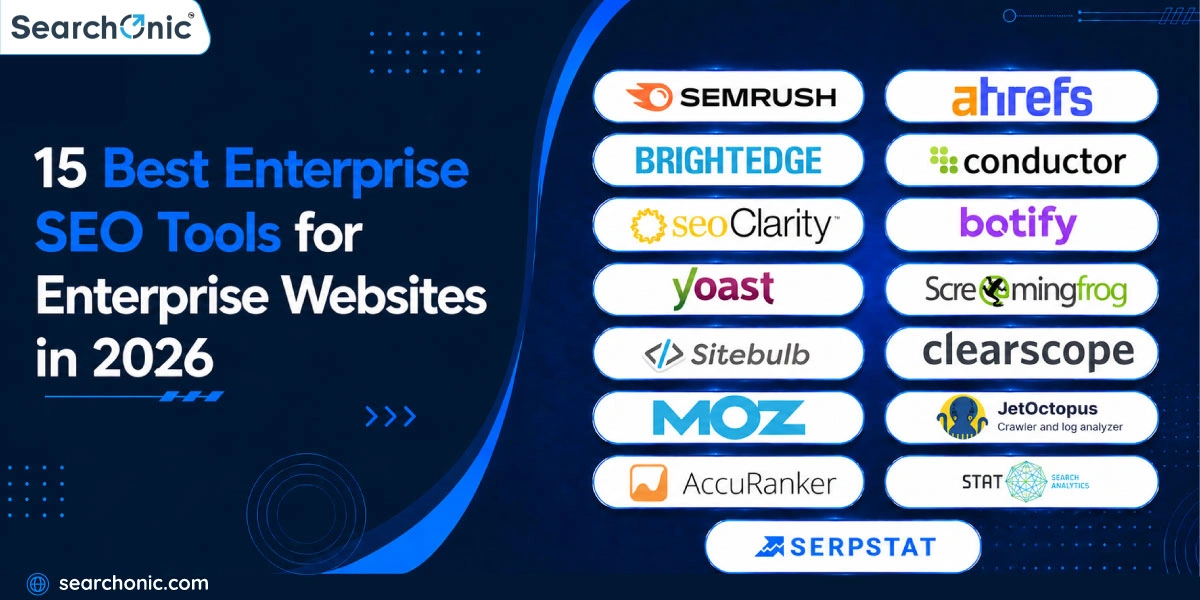
15 Best Enterprise SEO Tools for Enterprise Websites in 2026
August 6, 2026 By Mit Thakkar
Summarize this blog post with:
- What Are Enterprise SEO Tools?
- Why Do Enterprise Websites Need Specialized SEO Tools?
- ⮩ Managing Thousands of Web Pages
- ⮩ Tracking Large Keyword Portfolios
- ⮩ Enterprise-Level Technical SEO
- ⮩ Competitor and Market Analysis
- ⮩ SEO Reporting and Team Collaboration
- 15 Best Enterprise SEO Tools for Enterprise Websites in 2026
- 1. SEMrush Enterprise
- 2. Ahrefs Enterprise
- 3. BrightEdge
- 4. Conductor
- 5. seoClarity
- 6. Botify
- 7. Yoast SEO
- 8. Screaming Frog SEO Spider
- 9. Sitebulb
- 10. Clearscope
- 11. Moz
- 12. JetOctopus
- 13. AccuRanker
- 14. STAT Search Analytics
- 15. Serpstat
- Key Features to Look for in Enterprise SEO Tools
- ✦ Scalable Website Crawling
- ✦ Enterprise Keyword Tracking
- ✦ Technical SEO Monitoring
- ✦ Competitor Intelligence
- ✦ AI-Powered SEO Recommendations
- ✦ Reporting and Dashboards
- ✦ Integrations
- How to Choose the Right Enterprise SEO Tool
- ◈ Define Your SEO Requirements
- ◈ Consider Website Size
- ◈ Evaluate Automation Capabilities
- ◈ Check Integration Capabilities
- ◈ Consider Team Collaboration
- ◈ Evaluate Scalability
- Ready to Take Your Enterprise SEO Strategy to the Next Level?
Enterprise sites operate thousands of pages, various locations, and product categories, making SEO far more complicated than optimizing a small site. Balancing a large set of URLs, identifying technical SEO errors, monitoring rankings across various markets, and managing content quality can become tough without the ideal technology. This is when advanced SEO platforms become necessary.
Enterprise SEO services are more than traffic generation resources; they drive brand awareness, accelerate conversions, and uplift brand awareness. Enterprise SEO companies use these SEO tools to offer a centralized solution for measuring site performance, addressing technical errors, conducting keyword research, measuring backlinks, and generating brief reports. These tools have the potential to automate repetitive SEO tasks, support enterprise firms in managing optimization efficiently, and make data-backed decisions.
The market is filled with various SEO tools to choose from; all differ in terms of size and the functionalities they serve. If you own an enterprise-based firm with thousands of pages to audit, optimize, and monitor, it’s recommended to use an all-in-one SEO platform. For firms investing in the best enterprise SEO company, selection of an ideal tool can improve visibility, workflow efficiency, and long-term organic growth. Consider features such as website size, SEO requirements, reporting needs, integration, and automation when looking for SEO tools.
Read the guide to explore 15 best SEO tools for an enterprise site in 2026. These enterprise SEO tools cover platforms designed for various SEO requirements, from technical auditing to content optimization and keyword research. Whether you own a global brand or a multi-location site, these tools help to build a scalable SEO strategy.
What Are Enterprise SEO Tools?
An enterprise SEO tool is software designed to handle large amounts of data and deliver high-performance results for organic growth. Established online retail brands with large eCommerce sites must use these tools to improve their visibility on Google. Enterprise firms deal with countless pages, keywords, and marketing efforts all at once, and that’s why they look for enterprise SEO optimization services to automate their tasks. 22% of marketers said that their SEO & AI-search efforts are fully integrated across execution, strategy, and reporting. It highlights the necessity of enterprise SEO platforms that centralize workflows and performance reporting.
Unlike standard SEO software, which is designed for smaller sites & campaigns, enterprise tools can manage thousands of URLs, extensive keywords, multiple domains, and international markets. The advanced SEO tools offer a centralized dashboard for technical SEO assessment, keyword management, competitor analysis, backlink management, performance assessment, and content optimization. Automation is the key benefit, enabling the team to track errors, measure rankings, generate reports, and measure changes without relying on manual processes.
Tools used in enterprise SEO services also support collaboration by enabling SEO specialists, developers, content teams, and marketing professionals to collaborate from shared workflows. Large firms can use these platforms to coordinate SEO activities across departments and markets while managing consistent processes. Scalability, advanced reporting, and automations are a few features that make enterprise SEO tools valuable for managing complex SEO programs and long-term organic growth.
Why Do Enterprise Websites Need Specialized SEO Tools?
⮩ Managing Thousands of Web Pages
Manual monitoring is not practical due to the thousands or millions of URLs found on enterprise websites. Teams can prioritize pages that need to be optimized, analyze large URL inventories, and find crawl and indexing issues with the help of specialized SEO tools. This enables companies to effectively handle intricate content structures and extensive SEO campaigns while maintaining the health of their websites.
⮩ Tracking Large Keyword Portfolios
Thousands of keywords are frequently targeted by enterprise businesses across markets, locations, goods, and services. Teams can monitor visibility at scale with the use of specialized tools that track rankings across devices and locations. Additionally, enterprise SEO consultants find ranking opportunities, allowing SEO teams to make well-informed optimization decisions based on thorough ranking data.
⮩ Enterprise-Level Technical SEO
Complex technical problems with crawling, indexing, broken links, redirects, and website performance affect large websites. While tracking Core Web Vitals, specialized platforms assist in identifying and tracking these issues at scale. Because of this, they are useful for corporate enterprise SEO services, supporting improved search visibility, enhancing crawlability, and assisting teams in maintaining technical health.
⮩ Competitor and Market Analysis
Understanding competitors and shifting markets is essential for enterprise SEO. Businesses can compare organic visibility, find competitor keywords, assess search performance, and find backlink or content gaps with the help of specialized tools. With the help of these insights, SEO teams are able to identify market opportunities, comprehend competitive advantages, and create strategies that enhance their ranking in significant search results.
⮩ SEO Reporting and Team Collaboration
Centralized reporting is crucial because enterprise SEO involves numerous teams and stakeholders. Accessible SEO data, automated performance reports, and shared dashboards are all made possible by specialized tools.
With the use of consistent performance data across websites and markets, these capabilities assist SEO, content, development, and marketing teams. It helps in coordinating efforts, tracking advancement, communicating outcomes, and making well-informed decisions.
15 Best Enterprise SEO Tools for Enterprise Websites in 2026
1. SEMrush Enterprise

SEMrush Enterprise is an all-in-one SEO platform made for businesses that control numerous teams, websites, and markets. Keyword research, competitor analysis, backlink analysis, technical site auditing, rank tracking, content optimization, and AI visibility monitoring are some of its features. With JavaScript and Shadow DOM support, enterprise users can segment data, connect platforms like Google Analytics 4 and Google Search Console, and generate personalized reports.
Advanced automation, RBA, and centralized data management across teams and markets are some of its enterprise capabilities. Large companies can use these features to monitor competitors and find keyword and content opportunities. It identifies technical issues and measures SEO performance across complex digital properties more effectively.
2. Ahrefs Enterprise

Ahrefs Enterprise offers comprehensive data and tools for managing search performance at scale for large SEO teams. Site audit, keyword research, competitor analysis, backlink analysis, rank tracking, keyword clustering, and SEO opportunity discovery are important features. API access, Data Studio connectors, and portfolios that integrate metrics from various domains are examples of enterprise-specific features.
Additionally, Ahrefs offers webinars, multilingual support, customized onboarding, dedicated account management, and enterprise security features like single sign-on. Its extensive crawling infrastructure facilitates in-depth SEO monitoring and research. Ahrefs can assist teams in identifying technical issues, assessing competitors, and finding content opportunities. It keeps an eye on backlinks and organizes SEO data across various domains and business units for enterprise websites.
Also Read : Top 10 Enterprise SEO Tools to Boost Your Business in 2024
3. BrightEdge

BrightEdge is a platform for enterprise SEO and AI searches that integrates reporting, optimization, and research all in one platform. Keyword research, competitive analysis, real-time trends, technical site audits, on-page suggestions, content optimization, rank tracking, traffic reporting, and page-level performance analysis are some of its features. AI-focused features for tracking AI bot activity and search visibility are also offered by BrightEdge.
Business teams are able to link SEO data with CMS, analytics, and other platforms and generate personalized reports. Workflow capabilities facilitate role-based procedures, automated tasks, approval chains, and integrations with Monday.com, Jira, and Asana. These tools assist big businesses in prioritizing opportunities and measuring organic performance. It aims to coordinate SEO across departments and link optimization efforts to business results.
4. Conductor

The goal of Conductor, an enterprise SEO and AI search platform, is to link search insights, content, website performance, and business results. Conductor Intelligence, Conductor Creator, Conductor Monitoring, and AgentStack are all part of this. Content opportunity discovery, AI-assisted content creation, optimization, performance tracking, technical monitoring, and AI search visibility analysis are some of the features. RBA controls, custom segmentation, multi-domain reporting, and data source integrations are examples of enterprise capabilities.
From centralized dashboards, teams can examine performance across websites, brands, markets, and business domains. Businesses that require cooperation between SEO, content, marketing, and digital teams will find Conductor especially helpful. Organizations can find opportunities and scale optimization more reliably with its integration of search intelligence and content workflows.
5. seoClarity

An enterprise SEO platform called seoClarity combines rankings, technical SEO, content intelligence, analytics, research, and automation. Technical crawling, content analysis, keyword and topic research, competitor analysis, interactive rank tracking, and SEO analytics are some of its features. Additionally, the platform provides tools like Bot Optimizer, Page Optimizer, Schema Optimizer, Link Seeker, and SEO Split Tester.
APIs can be used by enterprise teams for content analysis, keyword research, domain research, and ranking data; integrations facilitate the integration of SEO intelligence with current workflows. Its reporting and segmentation features are intended for big datasets and intricate websites. These tools assist businesses in identifying opportunities and prioritizing content. It improves technical enhancements, automates tedious SEO tasks, and tracks performance across various markets and URLs.
6. Botify

Botify is an enterprise SEO platform with a strong emphasis on organic performance, crawling, indexing, and search engine behavior. In addition to supporting JavaScript rendering and extensive technical analysis, its SiteCrawler offers comprehensive information about the structure of websites and how search engines access pages. Additionally, Botify comes with LogAnalyzer, which shows how search engine bots interact with website URLs by combining crawl and visit data with server log data.
Teams can examine changes over time, technical problems, crawl frequency, indexability, and site structure. Additionally, Botify offers features for prioritization, monitoring, reporting, and data visualization. Its combination of crawler and log data can assist SEO teams in comprehending crawl behavior, identifying technical obstacles, and making more informed decisions. It has the potential to enhance search engine accessibility and organic visibility for large websites.
7. Yoast SEO

Teams can manage crucial on-page and technical SEO components directly within WordPress with the support of Yoast SEO, a WordPress SEO plugin. SEO analysis, readability analysis, XML sitemaps, structured data, Open Graph data, internal linking tools, and technical controls are some of its features.
Yoast creates advanced XML sitemaps automatically and lets users choose what kinds of content show up in them. While Premium offers extra content management features and internal linking recommendations, its Schema Framework generates connected structured data. Because Yoast integrates SEO controls into the publishing process, it is especially helpful for WordPress-based business websites. However, it mainly supports on-site optimization rather than extensive competitor research or enterprise rank tracking, in contrast to all-inclusive enterprise SEO platforms.
8. Screaming Frog SEO Spider

A robust website crawler for technical SEO audits is Screaming Frog SEO Spider. Broken links, redirects, duplicate content, missing or duplicate titles and meta descriptions, canonical problems, indexability signals, internal linking issues, and other technical errors can all be detected by it.
Additionally, the tool can generate XML sitemaps, analyze structured data, render JavaScript using Chromium, integrate with Google Analytics, Google Search Console, and PageSpeed Insights, and visualize website architecture. It can be used to analyze very large websites because of its configurable crawling and database storage options. SEO teams are able to plan crawls, compare audit changes, export data, and look into specific URLs. It is particularly useful for extensive issue identification and in-depth technical audits of business websites.
9. Sitebulb

A website auditing tool called Sitebulb was created to make technical SEO analysis simpler to comprehend and implement. Website architecture, indexability, internal linking, structured data, XML sitemaps, JavaScript rendering, and other areas are among the SEO problems that its crawler finds. Its prioritized “Hints,” which classify problems and explain why they are important, are one of its key advantages.
Additionally, audit comparisons are supported by Sitebulb, which enables teams to track changes between crawls and show advancement. Large-scale crawling is supported by its Cloud version without project, crawl-credit, or machine limitations. The platform can assist SEO teams in communicating technical findings to developers, managers, and stakeholders by offering customizable reports and visualizations. Businesses that require thorough technical audits with distinct priorities will find it especially helpful.
10. Clearscope

Clearscope is a platform for content optimization that aims to enhance the quality, comprehensiveness, and relevance of search-focused content. This tool, used in top enterprise SEO services, offers real-time content grading, topic coverage analysis, readability feedback, and suggestions derived from search result analysis. Teams can use the platform to find relevant topics, queries, and details that should be covered in content.
Additionally, it facilitates integrations with WordPress, Microsoft Word, and Google Docs, which helps remote content teams work together more easily. In addition to supporting content briefs and optimization workflows, Clearscope offers competitive content insights. It can help writers produce more thorough pages that are in line with search intent while preserving a consistent content workflow for enterprise organizations that publish a lot of content.
11. Moz

Moz is a reputable SEO platform that provides tools for backlink analysis, competitive research, site crawling, rank tracking, and keyword research. Teams can use its SEO toolkit to find search opportunities, track rankings, assess the health of websites, and comprehend link profiles.
Moz can be helpful for tracking changes in organic visibility, researching keywords, identifying technical problems, and evaluating competitors. While its site-crawling capabilities assist in identifying common technical SEO issues, its Link Explorer assists in the evaluation of backlink profiles. Moz, the best enterprise SEO tools 2026 can offer, is a centralized set of SEO research and monitoring tools for businesses. It is appropriate for businesses that need several SEO features on a single platform because of its extensive feature set.
12. JetOctopus

JetOctopus is an SEO crawler and log file analyzer made to assist teams in examining big websites and comprehending how search engines crawl them. While its Log Analyzer processes server log data to display how search engine bots and other crawlers interact with URLs, its crawler examines technical SEO elements and website structure. By crawler type, URL, status code, crawl frequency, and website section, the platform can separate logs.
Additionally, it facilitates integrations with infrastructure like AWS CloudFront and Cloudflare Enterprise. Enterprise SEO teams can find crawl waste, technical problems, poorly accessed pages, and indexing-related opportunities by combining crawl and log data. For large websites, where comprehending real bot behavior is crucial to enhancing crawl efficiency and technical SEO performance, JetOctopus is especially helpful.
13. AccuRanker

The goal of AccuRanker, a specialized rank-tracking platform, is to deliver precise and regularly updated keyword ranking information. It offers data like SERP positions, pixel positions, CTR, and AI Share of Voice and allows tracking at both the national and local levels. Teams can track changes in rankings to determine gains and losses in visibility and look into the performance of key terms across search results.
Agencies and enterprise SEO teams that require clear ranking data for stakeholders can benefit from its reporting capabilities. By offering specialized rank monitoring instead of combining numerous unrelated SEO features, AccuRanker can enhance more comprehensive SEO platforms. Its emphasis on ranking accuracy, segmentation, and performance monitoring can make it simpler for businesses to identify ranking changes and prioritize optimization initiatives.
14. STAT Search Analytics

For extensive SEO campaigns, STAT Search Analytics is a rank-tracking and SERP analytics platform. The best enterprise SEO tools focus on keeping an eye on competitors, keyword rankings, search engine results, and SERP elements in various markets and geographical areas. Enterprise teams can use its data to understand how competitors and brands show up in search results and address changes that might have an impact on organic visibility.
When businesses require comprehensive ranking intelligence across numerous markets and large keyword sets, STAT is especially helpful. Rather than taking the place of technical crawlers or content optimization systems, the platform can facilitate continuous monitoring and analysis. Its specialized approach to search analytics can help large SEO teams assess competitive visibility, find SERP opportunities, and inform stakeholders about search performance.
15. Serpstat

Serpstat is a comprehensive SEO platform used in corporate enterprise SEO services. It includes rank tracking, backlink analysis, competitor analysis, keyword research, and on-page optimization. The tool offers Keyword recommendations, search volume, keyword difficulty, CPC, and PPC competition data. Teams can find opportunities for content improvement, compare domains and keywords, analyze competitors, and find terms that are missing.
Serpstat is helpful for managing bigger keyword portfolios because it also supports daily rank tracking and keyword clustering. Its on-page SEO tools assist in locating problems that may impact the functionality of a website. By offering a wide range of SEO features in one setup, the platform helps enterprise teams become less dependent on numerous specialized tools. Organizations that require competitor research, ranking monitoring, keyword intelligence, and content optimization capabilities all at once will find it especially helpful.
Key Features to Look for in Enterprise SEO Tools
✦ Scalable Website Crawling
Enterprise SEO tools should be able to effectively crawl a lot of URLs and find technical problems on large websites. Without having to manually examine each page, automated site audits assist teams in regularly evaluating the health of their websites, identifying errors, and ranking issues.
✦ Enterprise Keyword Tracking
Check out platforms that can monitor extensive keyword portfolios across various search engines and regions. Businesses can track visibility, spot ranking shifts, and assess SEO performance in various markets with the help of comprehensive ranking data.
✦ Technical SEO Monitoring
Crawlability, indexability, canonical tags, redirects, and other technical aspects should be monitored by efficient tools. Enterprise teams can find problems that could impact search engine accessibility, website performance, and rankings.
✦ Competitor Intelligence
Businesses can compare organic visibility, keyword rankings, content performance, and backlink profiles with the help of competitor intelligence. By highlighting keyword gaps, backlink opportunities, competitive weaknesses, and areas where rivals dominate your website, these insights help enterprise SEO optimization services.
✦ AI-Powered SEO Recommendations
AI-powered features can identify optimization opportunities, evaluate website and content data, and automatically identify SEO problems. Teams can prioritize technical fixes, find ranking opportunities, enhance content relevance, and make decisions more quickly with the aid of these suggestions.
✦ Reporting and Dashboards
Customizable dashboards for tracking crucial SEO metrics across teams, markets, and websites should be offered by enterprise tools. Time is saved, performance tracking is consistent, and sharing SEO results with stakeholders is made simpler by automated reporting.
✦ Integrations
SEO platforms can communicate with Google Search Console, Google Analytics, CMS platforms, and BI tools thanks to strong integrations. By linking these data sources, teams can combine SEO insights with more comprehensive business performance data and establish a centralized workflow.
Also Read : List of Small Business SEO Services to Grow Your Local Business
How to Choose the Right Enterprise SEO Tool
◈ Define Your SEO Requirements
Identify the basic SEO goals such as technical auditing, keyword research, content optimization, monitoring rank, analyzing backlinks, and reporting. Select a platform that directly supports the specific goals and current SEO workflow.
◈ Consider Website Size
Measure whether the top enterprise SEO tools 2026 can effectively crawl & measure your site’s URL volume. Large enterprises must prioritize platforms capable of managing thousands of pages without hampering crawling speed, data accuracy, and reporting performance.
◈ Evaluate Automation Capabilities
Choose automation features that reduce repetitive SEO work, including scheduled crawls, ranking updates, monitoring alerts, and automated reports. Effective automation enables the team to track errors faster and focus on strategic optimization.
◈ Check Integration Capabilities
Select top enterprise SEO tools that integrate with platforms your team already uses, including Google Analytics, Google Search Console, CMS platforms, BI tools, and project management software. Strong integration allows centralized data & enhances workflow efficiency.
◈ Consider Team Collaboration
Enterprise SEO includes SEO professionals, content teams, developers, managers, and marketers. Choose an enterprise SEO tool offering various user roles, permissions, shared dashboards, customizable reports, workflow management, and collaboration features. These features allow the team to work efficiently from basic data.
◈ Evaluate Scalability
Select a platform that can scale along with your firm. Consider support for additional sites, URLs, markets, keywords & data sources. Scalable tools prevent businesses from facing frequent platform changes as their SEO requirements expand.

Ready to Take Your Enterprise SEO Strategy to the Next Level?
Enterprise SEO demands scalable tools that can manage complicated sites, a large set of keywords, multiple markets, and ongoing technical challenges. No single tool is ideal for every firm. So, firms must select tools based on their specific needs. Choose the best enterprise SEO tool depending on features such as technical SEO, content optimization, keyword monitoring, analytics, reporting, and competitor research.
Collaborating with a skilled enterprise SEO consultant helps firms choose the ideal technology and build an effective SEO operation. If necessary, businesses can combine multiple specialized tools to fulfill their various needs. The best enterprise SEO setup must prioritize scalability, seamless integration, automation, collaboration, and actionable metrics that support measurable long-term growth.

Mit Thakkar
CEO & Co-founder at Searchonic & Midas Touch Infotech. I help Businesses To Increase Traffic & Leads with the Help of SEO.
Add as a preferred source on Google
Ready to Take Your Brand to the Next Level?
Let's Connect